The Pagan Bookshelf is getting a little crowded lately, which is hardly the worst problem an editor can have!
I am blessed to review an impressive assortment (and number) of new books the publishers send our way, and rather than make good books wait patiently on the shelf for the next quarterly issue, we’re opening the doors a little wider here on the Green Egg Blog.
This week, three recent releases from Weiser Books approach personal transformation from very different directions. Amy Blackthorn takes plant magic into the shadowlands, Elwynn Green explores the liminal spaces of Witchcraft, and Leslie Tagorda asks what happens when astrology moves beyond telling us who we are and begins asking what we intend to do about it. Here is what I found between the covers.
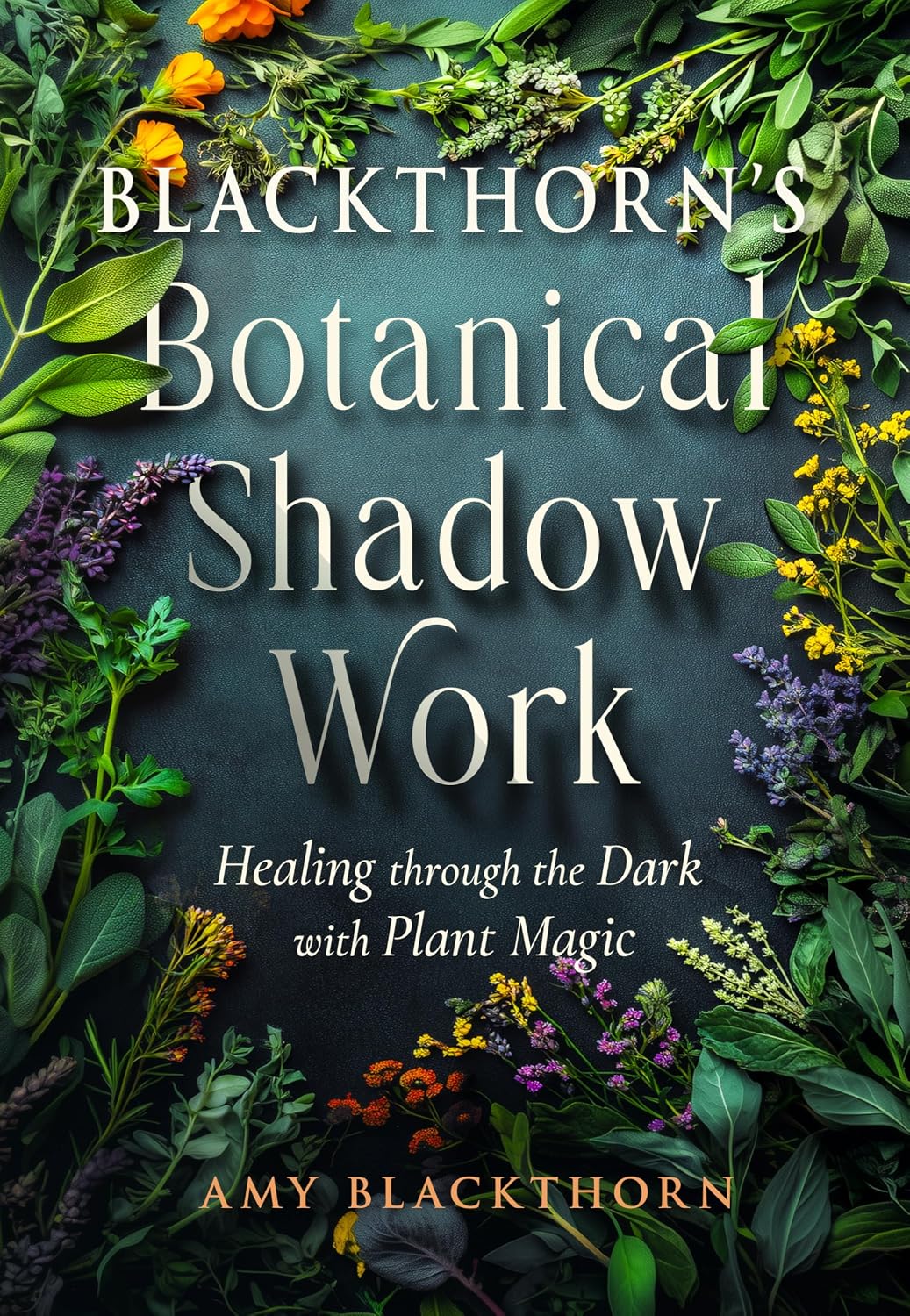
Blackthorn’s Botanical Shadow Work: Healing Through the Dark with Plant Magic
Amy Blackthorn
Weiser Books, 2026
Reviewed By Katrina Rasbold
There are some forms of magical work that lend themselves beautifully to books. You can learn correspondences, explore mythology, study divination systems, and collect spells without necessarily being required to dismantle yourself in the process. Shadow work is different. A book about shadow work is asking its reader to go somewhere potentially uncomfortable and, ideally, return knowing something they did not know before.
In Blackthorn’s Botanical Shadow Work, Amy Blackthorn approaches that journey with an unusual set of companions: plants. More specifically, she brings together shadow work, botanical magic, aromatherapy, plant-spirit communication, trance journeying, journaling, Tarot, and ritual to create a remarkably comprehensive system for examining the parts of ourselves we would often prefer to leave undisturbed. The result is not so much a book to read as a book to work through.
Blackthorn establishes early that this is intended to be a continuing practice rather than an assignment to complete. She encourages readers to return to the material as their lives change, even suggesting Samhain as an annual opportunity to revisit the work and discover what new “weeds” may have appeared in the garden. She is equally clear that readers should take what suits their culture, circumstances, resources, and experience and leave behind what does not. That flexibility is one of the book’s greatest strengths.
The book is arranged through five elemental realms—Fire, Air, Water, Earth, and Spirit—and moves from understanding the Shadow itself into increasingly applied work. Blackthorn considers botanical allies, plant-spirit communication, aromatherapy, therapy, liminal spaces, protection, Tarot, deity relationships, and finally bodily autonomy. This elemental progression gives what could easily become a sprawling collection of therapeutic and magical ideas a surprisingly cohesive structure.
What makes the botanical component particularly interesting is that plants are not merely ingredients here. Blackthorn treats them as personalities and allies. Readers meet them through imaginative trance journeys, learn to recognize ways plants might make themselves known, and consider the characteristics of particular botanicals as mirrors through which aspects of the self can be examined. In one of the book’s central explanations, she makes clear that these journeys are intended to introduce possibilities rather than dictate which plants a practitioner should work with.
This is where Botanical Shadow Work becomes considerably more engaging than another list of herbal correspondences. Blackthorn wants us to develop relationships.
Throughout the book, plants become conversation partners for difficult questions. Boundaries, grief, anger, fear, abandonment, shame, self-worth, trauma, spiritual relationships, and personal sovereignty are approached through encounters with botanical allies. The technique provides enough distance that difficult questions can sometimes be approached sideways rather than head-on.
Blackthorn’s guided journeys are especially effective in this regard. An early journey invites the reader to attend a symbolic farewell to an earlier version of themselves, placing guilt, shame, anger, and whatever else they are ready to release into an empty casket before allowing that former self to depart. It is theatrical, certainly, but ritual is supposed to be theatrical. Symbolism gives our minds something tangible to do with an intangible experience.
Importantly, Blackthorn does not present magical practice as a replacement for mental-health care. She explicitly states that self-directed shadow work is not a substitute for therapy or medical intervention and recognizes the particular role of trained therapists in challenging perceptions and helping clients untangle difficult patterns. The book also includes cautions concerning botanical and essential-oil use and directs readers toward appropriate healthcare rather than presenting plant magic as medical treatment.
I appreciated Blackthorn’s insistence that difficult emotions are not evidence of spiritual failure. Anger, in particular, is permitted its rightful place. She rejects the notion that an angry person is necessarily fearful or “unhealed,” instead presenting anger as something that can reveal mistreatment and violated boundaries. “Empathy without boundaries is self-destruction,” she writes in a particularly memorable section. Anyone who has spent much time in spiritual communities has encountered the pressure to transcend perfectly reasonable human emotions in the name of enlightenment. Blackthorn is having none of it.
Neither does she demand that readers perform healing correctly. Her repeated accommodations for disability, neurodivergence, financial limitations, different sensory experiences, and individual spiritual practices make the book unusually welcoming. Visualization is not treated as mandatory, journaling need not be done on paper, elaborate ritual equipment is unnecessary, and readers are repeatedly reminded that there are no prizes for suffering.
The later chapters bring the earlier material toward a theme that has quietly been present throughout: sovereignty. The ritual for reclaiming bodily autonomy, for example, asks readers to symbolically cut apart bindings representing injustice, fear, doubt, or abuse. The final Spirit journey then brings together symbols accumulated through the elemental work and culminates in the presentation of a crown representing personal sovereignty. It provides a satisfying magical conclusion to a book concerned not with becoming someone entirely different, but with reclaiming authority over the person already there.
This is also a book that should be taken slowly. Reading the exercises without doing them will provide information, but it misses much of the point. Blackthorn has constructed an experiential journey in which the reader’s own memories, responses, imagination, and relationships with the botanical world supply a significant portion of the material.
Blackthorn’s Botanical Shadow Work succeeds because it does not promise that darkness can be banished with the correct herb, essential oil, meditation, or spell. The Shadow is not treated as an enemy to destroy. Blackthorn repeatedly reminds us that these parts of ourselves developed for reasons, often in response to experiences we did not have the resources to process at the time. Shadow work, in her telling, is ongoing and deeply individual. The plants simply accompany us into the garden.
For practitioners drawn to botanical magic who are ready for more introspective work—or readers already engaged in shadow work who would welcome a distinctly Witchy and plant-centered approach—Blackthorn’s Botanical Shadow Work offers a thoughtful, compassionate, and highly usable guide. Amy Blackthorn has created something more valuable than a collection of correspondences: a framework through which plants, magic, ritual, and self-examination can become part of the same conversation and sometimes, when we are going into the darkest shadows, it is good to have something growing beside us.
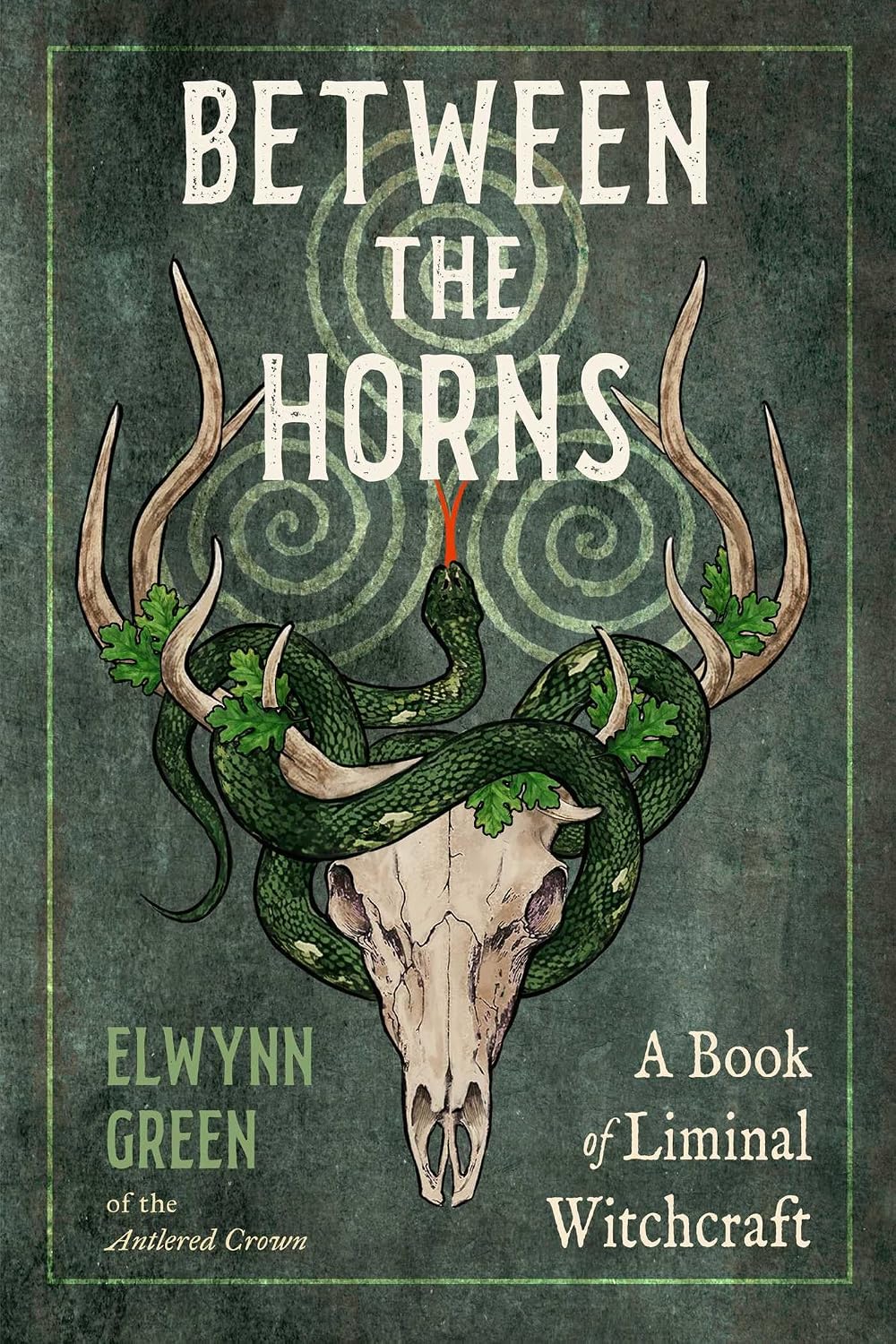
Between the Horns: A Book of Liminal Witchcraft
By Elwynn Green
Weiser Books, 2026
Reviewed By Katrina Rasbold
There comes a point in the development of a magical practitioner when learning what other people do becomes considerably less important than discovering what you do. Books, teachers, traditions, correspondences, and inherited instructions can give us a foundation, but eventually the Witch has to stop asking for a recipe and begin developing a relationship with the ingredients. Elwynn Green’s Between the Horns: A Book of Liminal Witchcraft is written for that threshold.
Green offers a Witchcraft that is personal, experiential, animistic, and occasionally uncomfortable. This is not a book particularly interested in making Witchcraft prettier, safer, or more socially palatable. Neither, despite its grounding in traditional and folkloric Witchcraft, is it interested in handing the reader another rigid tradition to adopt wholesale. Green encourages readers to test, observe, experience, question, and ultimately construct a practice that actually belongs to them.
That alone gives Between the Horns a refreshing quality in an increasingly crowded Witchcraft marketplace. Green specifically describes his approach as heuristic, emphasizing self-directed discovery rather than unquestioning adherence to a prescribed system. That emphasis on developing a personal magical path is also central to the publisher’s description of the work.
The book begins with what Green calls the Three Pillars of Magic: Truth, Self, and Will. Rather than presenting these as commandments, he deliberately destabilizes them. Truth is mutable. Self is constructed and continually changing. Will is not simply wanting something badly enough and forcing the universe to comply. Green uses these concepts to begin dismantling the reader’s assumptions about how magic operates and, perhaps more importantly, about the person performing it. That process of dismantling continues throughout the book.
Green is particularly interested in perception. Magical correspondences, for instance, are not presented merely as an inherited catalog of what a plant, stone, color, or object is supposed to mean. Personal association matters. The Witch’s relationship with the material matters. Experience matters. Folk magic is wonderfully inconsistent precisely because it developed through individual people interacting with their environments rather than through a centralized governing body issuing approved correspondence charts. This emphasis allows the book to move beyond theory into genuinely useful practice.
Green explores tools, ingredients and associations, the Witch’s Compass, protection and banishment, divination, spirit relationships, the Witches’ Devil, spirit flight, and ultimately the process of “becoming the Witch.” Throughout these chapters are exercises and workings designed not simply to demonstrate his practice but to encourage readers to investigate their own.
Some of the most effective material concerns interaction with the natural and spirit worlds. Green approaches animism as something lived rather than merely professed. A house can become a spiritual ally through years of habitation, ritual, celebration, protection, and relationship. Plants become collaborators rather than ingredients. Spirits are approached through hospitality, offerings, boundaries, observation, and repeated contact. His suggested spirit feast, for example, emphasizes welcoming spirits as honored guests, feeding them, spending time in proximity to the offering, and then clearly closing the encounter. That relational approach is one of the book’s greatest strengths.
I was also pleased by Green’s treatment of divination. Rather than framing it primarily as prediction of an immutable future, he describes divination as perception of patterns within an interconnected and continually moving world. He encourages practitioners to discover the divinatory language that works naturally for them rather than struggling indefinitely with the system they believe they should master. His own childhood experience of finding greater fluency casting personally meaningful objects than working with runes makes the point beautifully.
The later chapters move farther into territory often omitted from introductory and intermediate Witchcraft books. Green discusses familiars, the Witches’ Devil, the fetch, spirit flight, the sabbat, and relationships with spirits of place. Here Between the Horns becomes considerably more distinctive. Whether or not the reader shares Green’s cosmology, these chapters offer something far more interesting than another recycled explanation of elemental correspondences.
His discussion of spirit flight is especially intriguing. Green presents it as a skill developed incrementally through training the mind, imagination, and perception, eventually moving into his understanding of the sabbat as an encounter involving spirits, familiars, other Witches, and the Devil of the land. The reader does not have to adopt that cosmology literally to find considerable material for contemplation within it.
Green’s writing voice is a significant part of the experience. He can be poetic, irreverent, opinionated, earthy, funny, and occasionally confrontational. His family traditions, personal experiences, observations, theories, and prejudices are visible throughout the text. Importantly, he does not require the reader to accept all of them. From the beginning, Between the Horns encourages experimentation rather than passive belief.
That invitation to discernment is particularly useful because Green writes with confidence and does not shy away from strong assertions about magic, spirit interaction, energetic influence, and the consequences of magical practice. Some readers will embrace that certainty, while others may prefer to regard portions of the book as expressions of Green’s personal cosmology rather than universal principles. His use of psychological, physiological, and occasionally scientific language alongside magical concepts also rewards a discerning reader who is comfortable separating metaphor, personal experience, and established fact.
That need not diminish the value of the magical material. Witchcraft has always occupied territory in which experience, folklore, inherited belief, personal gnosis, and observable reality mingle somewhat untidily. A useful magical book need not resolve all those tensions for us. Sometimes its job is simply to give us worthwhile material with which to wrestle.
Experienced practitioners will almost certainly encounter assertions they interpret differently. That, too, can be useful. A worthwhile magical book should occasionally make us put it down and stare suspiciously into the middle distance.
Green also offers one piece of advice I particularly appreciate: mind your own business. He cautions practitioners against magically intervening in other people’s situations merely because they possess the ability to do so, observing that unsolicited involvement can leave us fighting battles that were never ours. It is an admirably practical observation in a field that sometimes encourages practitioners to perceive every problem as an invitation for magical intervention.
For newer Witches, Between the Horns provides enough practical instruction to offer footing without insisting that Green’s path become their own. For experienced practitioners, its greater value may lie in the questions it raises and in those less frequently discussed areas of traditional Craft that invite renewed exploration.
Ultimately, the liminality promised by the title extends beyond spirit encounters and hedge-crossing. The Witch Green describes occupies the territory between civilized and wild, mundane and supernatural, certainty and uncertainty. Indeed, he describes the Witch as a liminal creature who exists at the boundaries between worlds rather than fitting comfortably into one defined place. That is where Between the Horns succeeds most strongly. It does not offer another identity for the reader to put on or another prefabricated magical system to reproduce precisely.
Instead, it asks what might happen if we become sufficiently comfortable with uncertainty to develop a Witchcraft born of relationship, observation, experience, experimentation, and the strange places we discover for ourselves.
For practitioners ready to move beyond simply learning Witchcraft and begin deciding what their own Witchcraft actually means, Between the Horns offers a provocative and worthwhile companion for the journey.
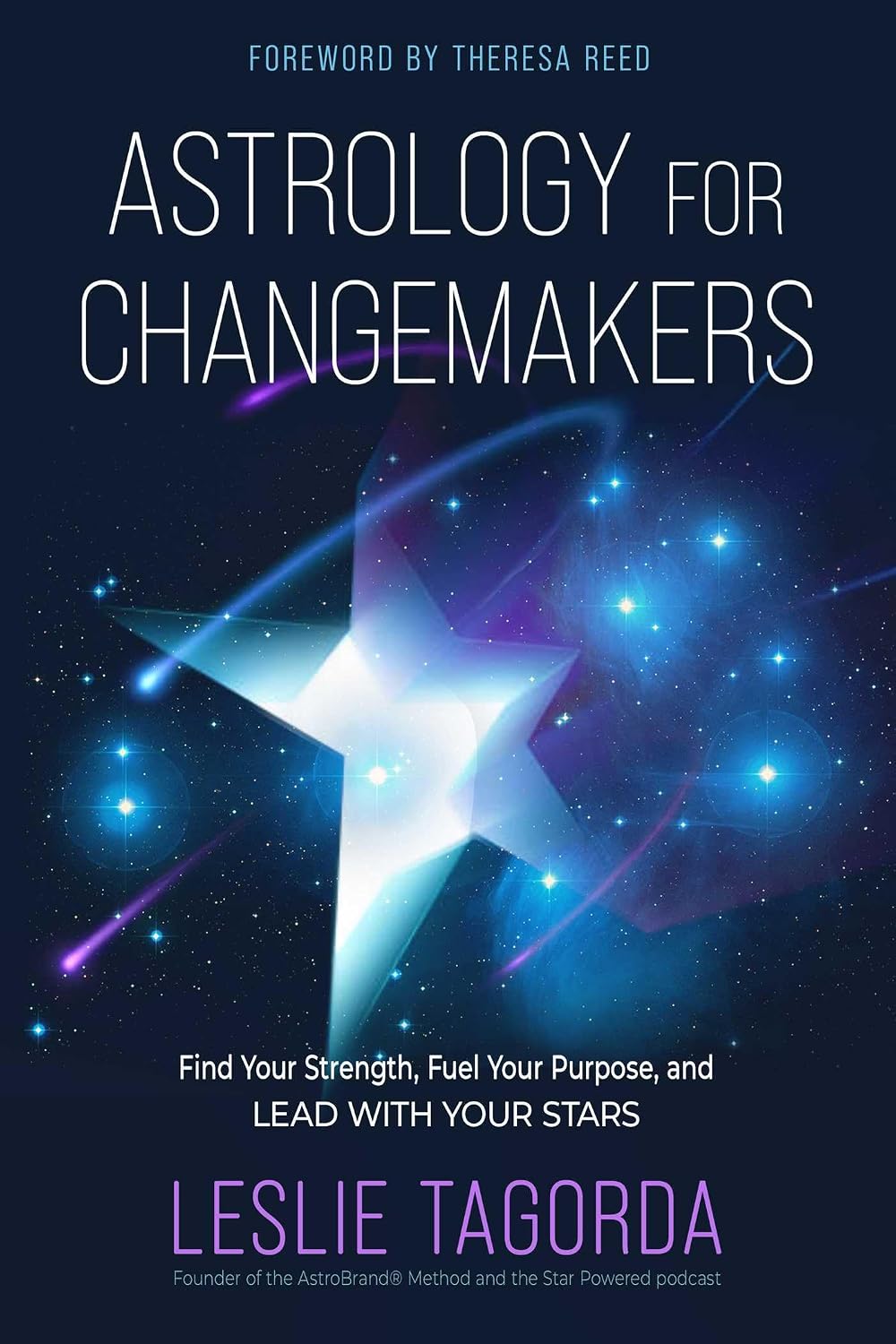
Astrology for Changemakers: Find Your Strengths, Fuel Your Purpose, and Lead with Your Stars
by Leslie Tagorda
Weiser Books
Reviewed By Katrina Rasbold
There are plenty of astrology books devoted to telling us who we are. Leslie Tagorda’s Astrology for Changemakers is interested in a somewhat different question: Now that you know who you are, what are you going to do with it?
Tagorda approaches the natal chart as a map not only of personality, but of leadership, purpose, contribution, and impact. Her definition of leadership is deliberately broad. A changemaker need not be a CEO, politician, activist, or public figure. Parents, teachers, healers, artists, entrepreneurs, caretakers, and community builders all influence the world around them. Leadership, in this framework, begins whenever we use what we have learned and experienced to create change. That distinction gives the book its particular usefulness.
Tagorda is a Filipino-American astrologer as well as a longtime brand strategist, and the latter experience becomes increasingly evident as the book progresses. Rather than using astrology primarily for prediction, compatibility, or forecasting, she asks readers to identify what makes their particular combination of astrological energies valuable. The natal chart becomes what she calls our “original design”: a collection of strengths, values, motivations, challenges, and potential expressions that can help us understand how we naturally contribute.
This is not, however, an astrology book written only for people who already know how to read a chart. Tagorda spends considerable time establishing the necessary foundations. Zodiac signs are explored as archetypes of change, planets as processes of change, houses as areas of change, and aspects as relationships of change. Experienced astrologers may move quickly through some of this material, but newcomers receive enough instruction to understand the system Tagorda develops later.
One of the more appealing aspects of her approach is her resistance to treating astrological placements as inherently “good” or “bad.” Even traditionally difficult aspects are presented as containing both strengths and challenges. Likewise, she repeatedly asks readers to examine the stories they have absorbed about particular traits. Is sensitivity weakness? Is ambition selfish? Is emotional labor less valuable than more visibly assertive forms of leadership? Where did those judgments originate, and do we still want to carry them?
This emphasis on reclamation runs throughout the book. Tagorda is particularly interested in readers who have felt poorly represented by conventional ideas of leadership, including women, BIPOC, queer and nonbinary people, neurodivergent people, and those who have otherwise been encouraged to conform themselves to established expectations. Her astrology consequently becomes less about receiving a cosmic verdict and more about acquiring language for qualities already present.
The most distinctive portion of Astrology for Changemakers comes when Tagorda brings astrology together with her experience in branding and positioning. She concentrates on what she calls the “Big 4”: the Sun, Moon, Rising sign, and Descendant. The Sun describes the what of our contribution, the Moon the emotional why, the Rising sign the how, and the Descendant the who—the people with whom we are particularly equipped to connect, collaborate, or serve. It is a surprisingly effective organizing device.
In the final portion of the book, readers begin combining what they have learned rather than simply accumulating interpretations. Tagorda borrows the concept of “positioning” from branding: identifying what you do differently, why you do it, how you accomplish it, and whom you serve. She then maps those questions onto the Big 4. Astrology therefore becomes actionable rather than merely descriptive.
That practical orientation may be the book’s greatest strength. There is a great deal here to work through, and this is better approached with a natal chart, notebook, and willingness to stop periodically and consider the questions than as a book to race through from beginning to end. Tagorda wants readers not simply to recognize themselves in an interpretation, but to find concrete examples of how their astrological strengths have already manifested in their lives and then consciously put those strengths to use.
Her tone throughout is encouraging and frequently enthusiastic. Readers who prefer highly traditional, technical astrology should know that this is decidedly not that book. Tagorda’s perspective is contemporary, spiritually oriented, socially conscious, and firmly rooted in personal agency. She explicitly rejects the idea that the natal chart represents an unavoidable fate, emphasizing instead choice in how its possibilities are expressed.
For readers already comfortable with astrology as a tool for self-knowledge, however, Astrology for Changemakers offers an interesting next step. Instead of asking the chart endlessly to explain us to ourselves, Tagorda asks us to turn outward.
What have you learned? What can you contribute? Who needs what you have to offer? And what might happen if, rather than trying to become someone more suitable for leadership, you began with the possibility that your particular way of moving through the world is precisely where your leadership begins?
That makes Astrology for Changemakers a thoughtful addition to the modern astrological bookshelf, particularly for readers interested in purpose, vocation, entrepreneurship, activism, community work, or simply finding a more intentional way to use the strengths they already possess.
Want to join the conversation about this blog post? Go to the Green Egg Forum and scroll for the forum post that relates to this article
 As Editor of the Green Egg Blog, Katrina Rasbold weaves ancient wisdom into the complexities of modern life, fostering a space for deep inquiry and magical growth. Katrina is the editor of Green Egg Magazine, a priestess, author, and co-creator of the CUSP path, working from the crossroads of tradition and transformation. She owns and operates Crossroads Occult with her husband, Eric, offering a sanctuary for those seeking mentorship, quality handmade magical items, and authentic craft. Discover her full body of work at www.katrinarasbold.com.