I don’t know, sweetheart. It looks like a piece of a sprinkler.
Continue reading The Trouble With Being the Witch in the Family
I don’t know, sweetheart. It looks like a piece of a sprinkler.
Continue reading The Trouble With Being the Witch in the Family
I have some concerns about the veil. Not just “the veil,” but “The Veil.”
Apparently, it has been thinning for several months now. Possibly years. Every Samhain, certainly. During eclipses. Around full moons. During various astrological events. On numerologically interesting dates. Occasionally on Tuesdays.
At this point, the veil has been thinning so frequently that I am concerned about its structural integrity.
Somebody should probably call maintenance. Continue reading Does Everything Have to Be So Dramatic?

The publishing world moves quickly, and even good books can disappear from view once the excitement surrounding their release has passed. For this edition of The Pagan Bookshelf, we are stepping away from the newest arrivals and reaching back a little farther for two Moon Books titles that deserve another look. Robin Herne’s Pantheon: The Egyptians was published in 2021, followed by Halo Quin’s Crimson Craft in 2023, but neither book has lost its relevance simply because newer titles have since crowded onto the shelves. Sometimes the best addition to our reading list is not the book everyone is talking about right now, but the one we somehow missed the first time around. Continue reading Books You May Have Missed

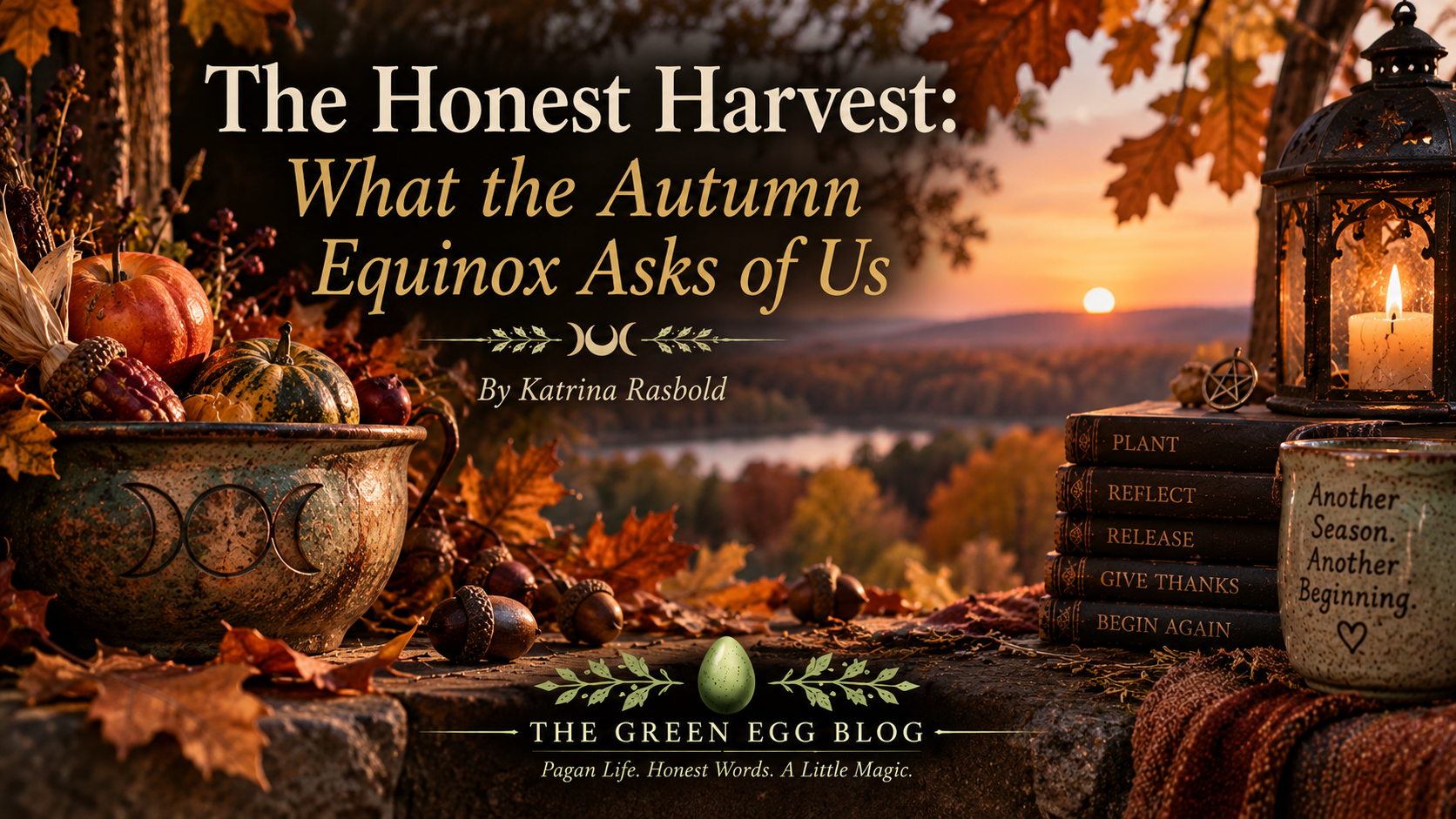
There is something almost suspiciously tidy about the Autumn Equinox. Light and dark are balanced, the harvest is gathered, baskets of apples appear everywhere, pumpkins glow obligingly in the background, and a few artfully arranged acorns complete the picture. Perhaps there is a cinnamon broom involved if we are feeling particularly festive. Pagans are very good at autumn. Give us a crisp morning, a candle, and something orange and we will absolutely make a religion out of it.
And yet, the older I get, the less I think the Autumn Equinox is really about any of those things. Increasingly, I think it is about reckoning—not the ominous, thunder-on-the-horizon sort of reckoning but reckoning in its older and simpler sense of counting up, taking stock, and looking honestly at what came from what we planted. The harvest does not care what we intended to grow. It shows us what actually grew, and there is something profoundly Pagan about that. Continue reading The Honest Harvest: What the Autumn Equinox Asks of Us

This visit to The Pagan Bookshelf brings together three books concerned, in very different ways, with what we make of ourselves. Loren Morris puts cord magic quite literally into our hands, Shavonne Readus approaches Tarot as a means of developing confidence and self-understanding, and Madison Murphy Barney invites us into the decidedly stranger territory suggested by a title like Our Ancestors Want Us to Be Mushrooms.
Practical magic, Tarot, ancestry, identity, and transformation make unusual shelfmates, perhaps, but Pagan bookshelves have never been particularly interested in behaving themselves. Let’s see what these three have to offer.

Few publishers have embraced the sheer breadth of contemporary Paganism quite like Moon Books, and this week’s Pagan Bookshelf demonstrates just how many directions that breadth can take us. We have dragons and ancient lore, Irish mythology in fresh translation, the enduring presence of Herne the Hunter, and Witchcraft steeped in the color, fragrance, history, and magic of lavender.
These four books range from scholarship and folklore to devotional and practical magical work, but all share an interest in looking more closely at the stories, beings, traditions, and natural allies that continue to shape Pagan practice. Whether your interests run toward Celtic myth, legendary creatures, the wild forest, or the Witch’s garden, there is quite a bit here to explore. Continue reading New From Moon Books!


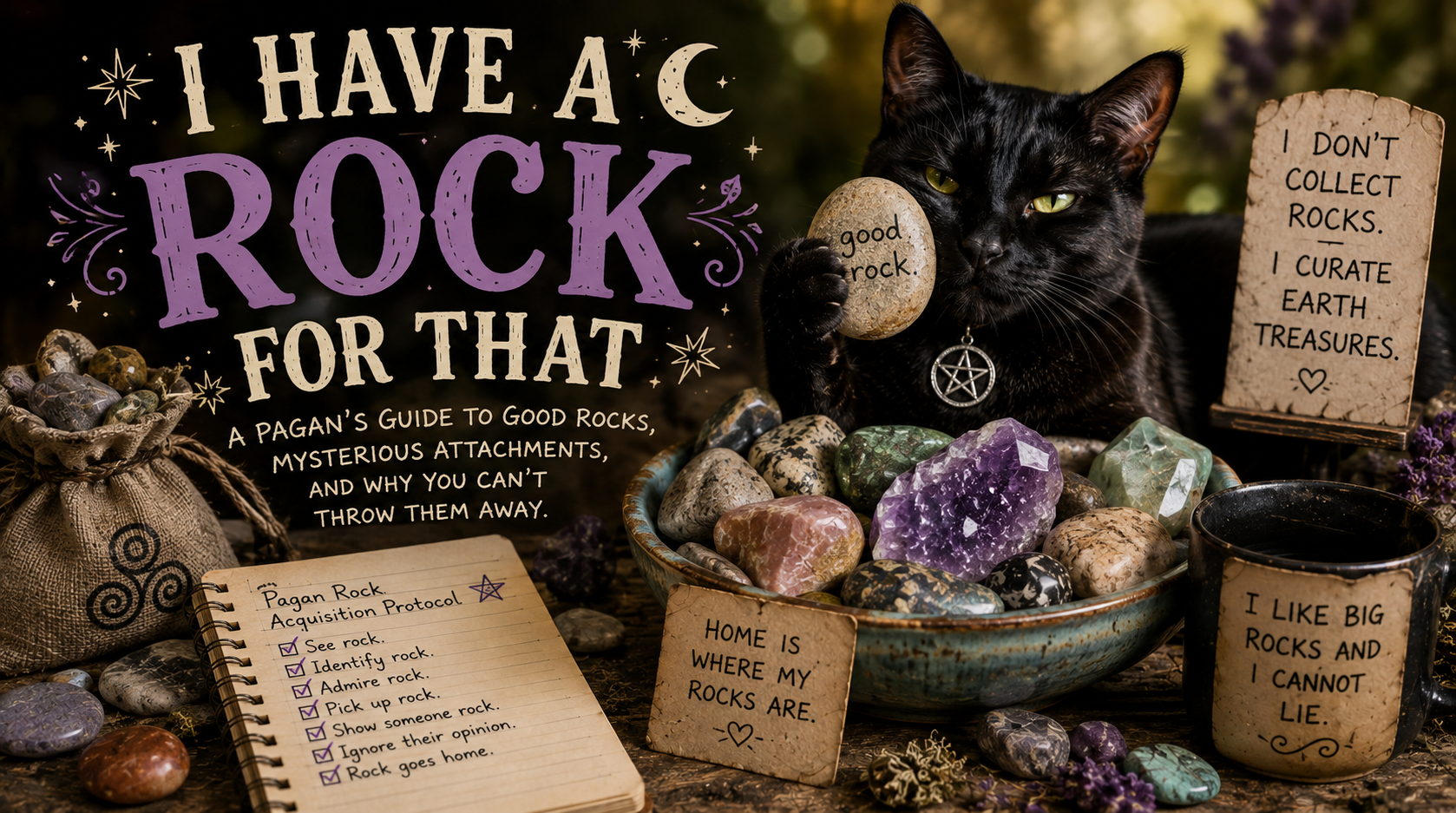
There is a particular sound a Pagan makes when encountering a good rock. It isn’t quite a word. It’s more of an oooh. The rock may be lying beside a creek, embedded in the dirt along a trail, sitting at the edge of a parking lot, or minding its own business somewhere completely unremarkable. This does not matter. Something about it has caught our attention, and now we must pick it up.
I have a strong working knowledge of stones. I can usually identify what I’m looking at, and I’m familiar with the magical and metaphysical properties traditionally associated with many of them. This does absolutely nothing to prevent the ancient instinct known as Good rock. Must have. Continue reading I Have a Rock for That

By Katrina Rasbold
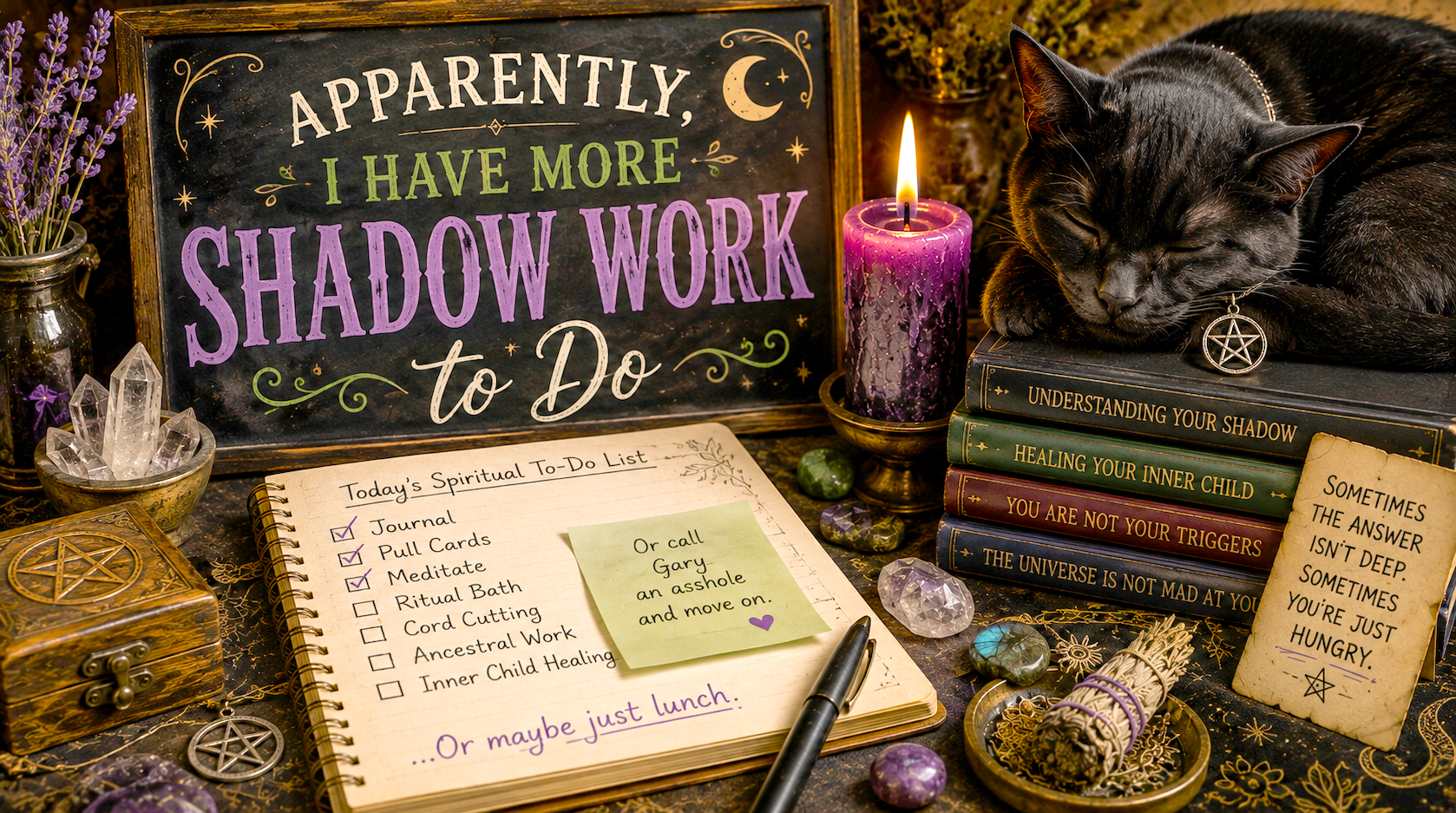
I miss the days when being irritated with someone meant I was irritated with someone. These days, apparently, I need to examine why this person triggers me, determine what they’re mirroring back to me, identify the unhealed wound they’ve activated, journal about my response, pull three Tarot cards, take a cleansing bath, and investigate whether the whole mess originated with my maternal ancestors.
I was hoping to just call them an asshole and get on with my afternoon.
Welcome to shadow work. Continue reading Apparently, I Have More Shadow Work to Do

By Katrina Rasbold
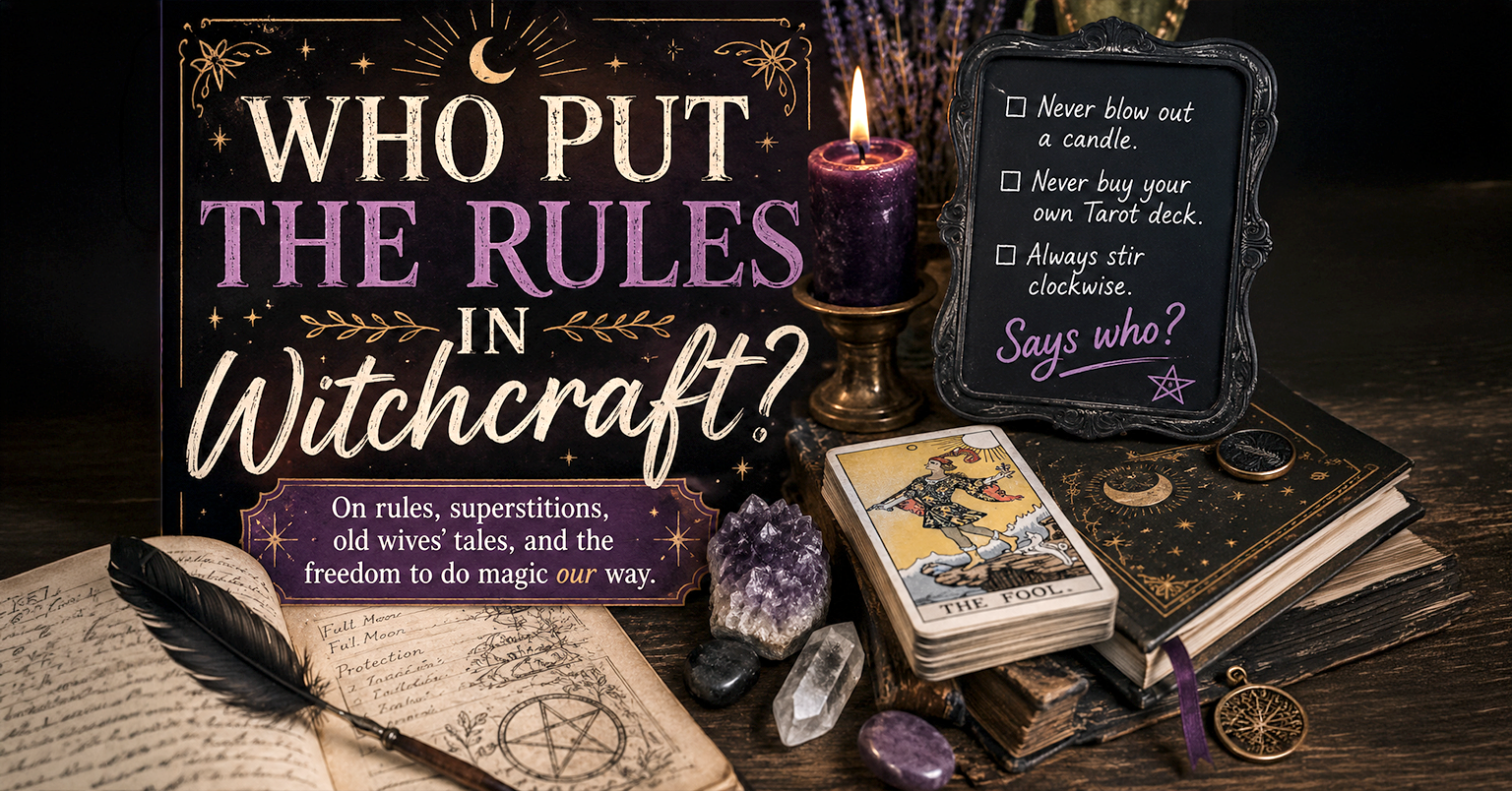
Somewhere, at some point, someone decided you should never buy your own Tarot cards.
I would very much like to meet this person.
Mostly because I have questions.
Who does buy them, then? Is there a designated Tarot distribution committee? Do I submit an application? What happens if nobody in my family takes the hint? Am I simply destined to wander through life Tarotless until a mysterious benefactor recognizes my readiness and presents me with a Rider-Waite deck? Continue reading Who Put the Rules in Witchcraft?

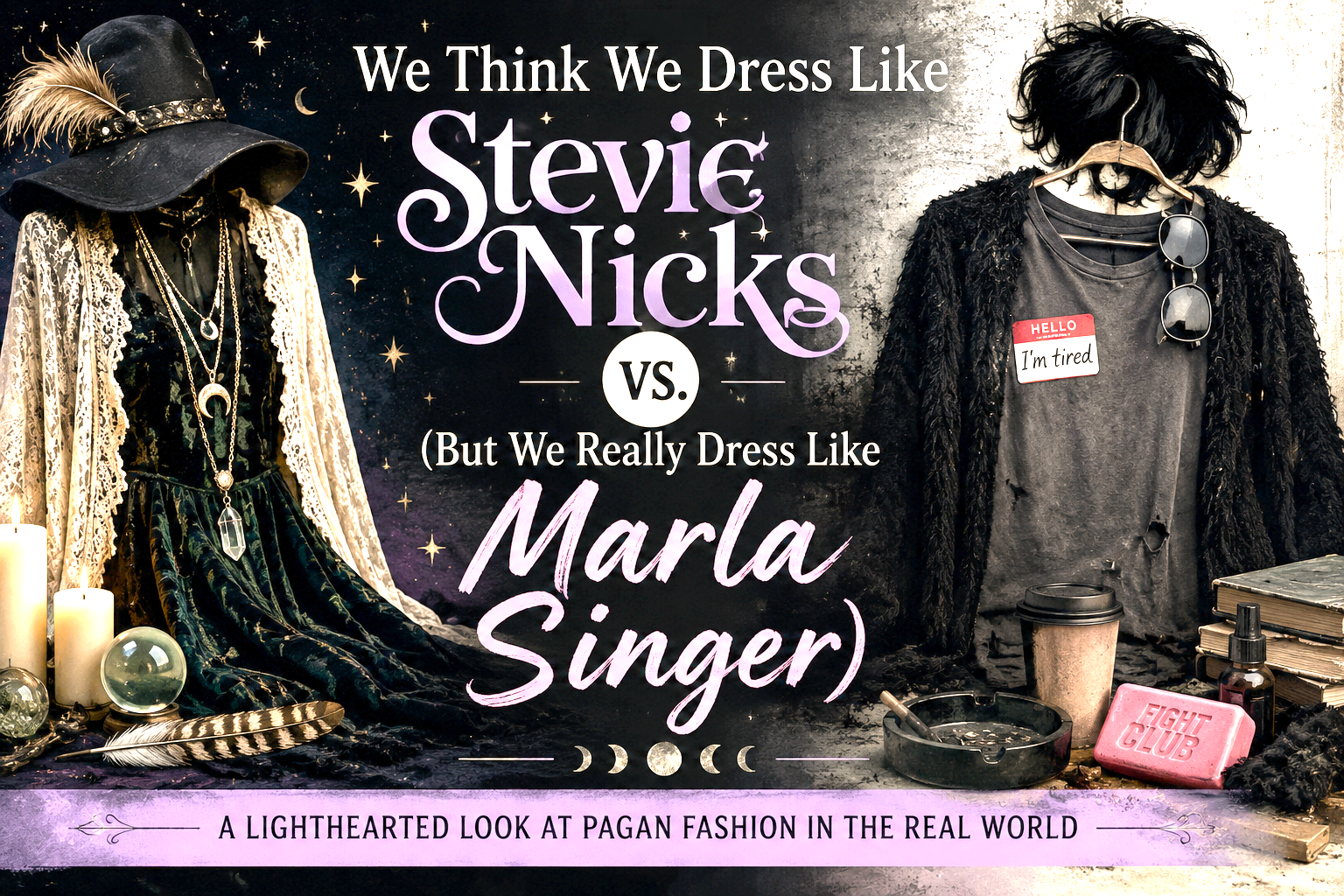
Every generation of Pagans seems to have an unofficial fashion icon.
If social media is to be believed, we’re all gliding through forests in flowing black velvet, trailing lace sleeves, silver jewelry, and enough dramatic scarves to supply an off-Broadway production of Macbeth. Somewhere in the background, Stevie Nicks is singing while ravens circle obligingly overhead.
It’s a lovely image.
It just doesn’t happen to resemble most of the Pagans I know. Continue reading We Think We Dress Like Stevie Nicks (But We Really Dress Like Marla Singer)

By Katrina Rasbold
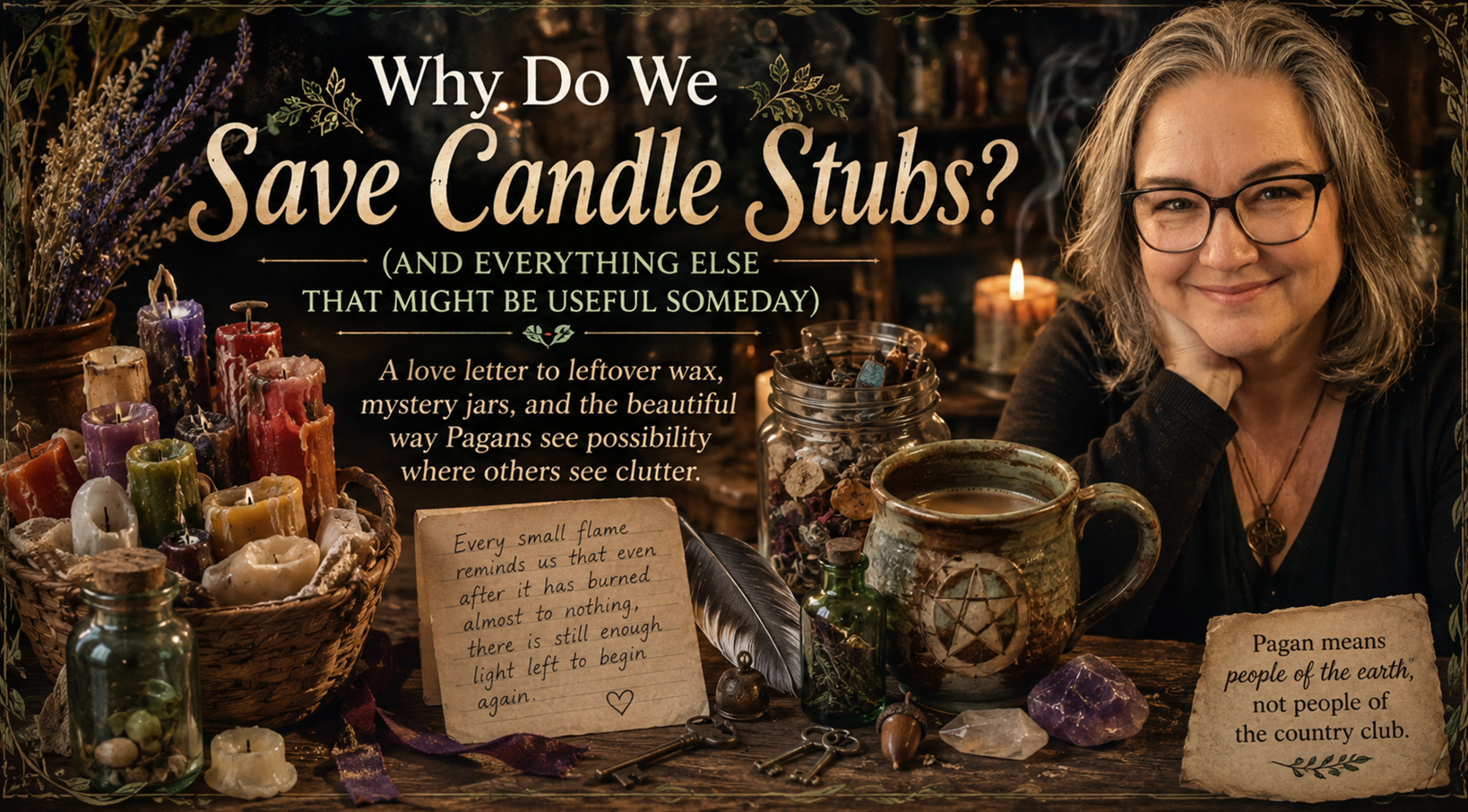
I was looking for one particular candle the other day.
Not a fancy one. Not the expensive beeswax pillar I’d been saving for some future occasion worthy of its existence. I was looking for a little red candle that had already done its job. It had burned down to a crooked little nub, with barely enough wax left to stand on its own.
Naturally, I couldn’t find it.
What I could find was an entire box of other candle stubs. Continue reading Why Do We Save Candle Stubs?

By Katrina Rasbold
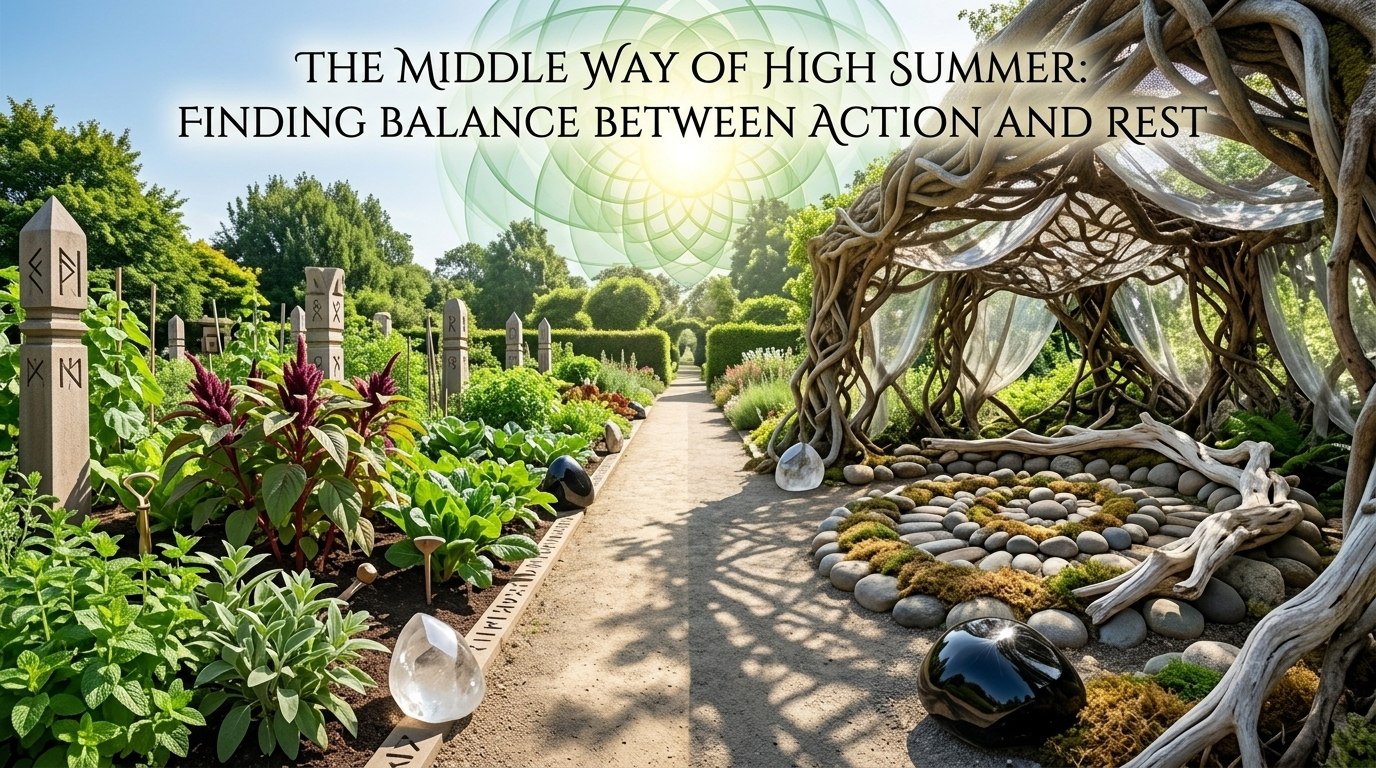
We are sitting squarely in the middle of July. The excitement of the Summer Solstice has passed, the intense alchemical heat of the summer crucible is blazing all around us, and yet, the first harvest of Lammas is still just on the horizon. In this dense, shimmering stretch of the year, a strange kind of spiritual exhaustion can creep into our circles.
Our agrarian ancestors knew that this was a period of tense waiting. The crops were in the fields, baking under the solar furnace, but they weren’t ready for the sickle. If you pushed too hard, you ruined the yield. If you did nothing, the weeds took over. Survival depended on mastering a delicate, high-summer equilibrium.
For the modern practitioner, this mid-July station offers a profound lesson in the Middle Way—the art of balancing fierce external action with deep internal restoration. Continue reading The Middle Way of High Summer: Finding Balance Between Action and Rest

By Katrina Rasbold
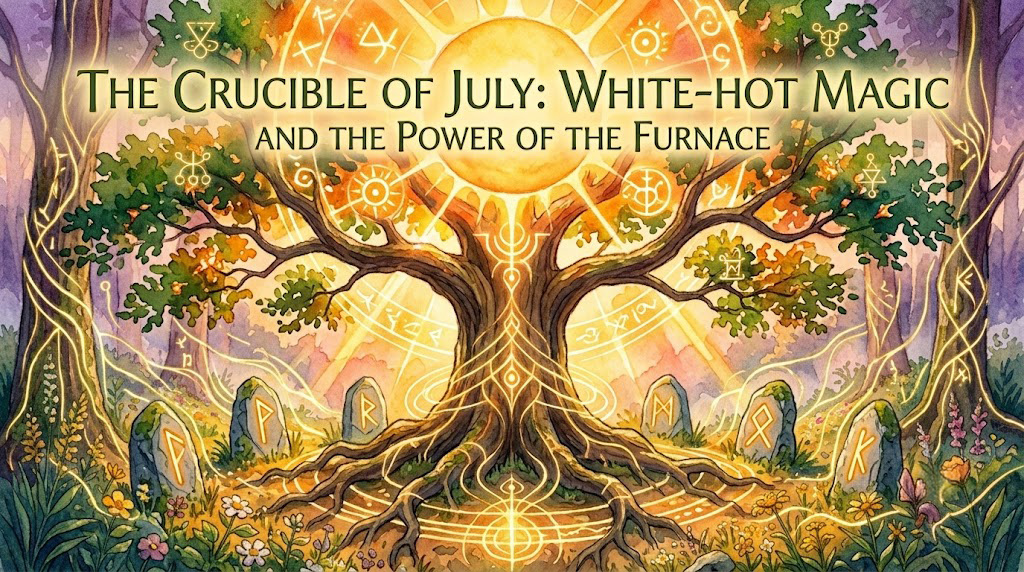
Look outside your window during the mid-afternoon hours of July, and you will see a landscape standing in a state of absolute, baking intensity. The gentle, shifting rains of spring are a distant memory. The soil is hard, the air is thick with heat, and the sun hangs in the sky like an unblinking, golden eye.
In modern society, we spend this month retreating indoors, turning up the air conditioning, and waiting for the temperature to drop. We treat the high heat as an inconvenience to endure.
But ancient earth-spiritual traditions view this specific stretch of summer completely differently. They recognize it as the crucible of the year.
A crucible is a severe test—a vessel designed to withstand extreme temperatures so that whatever is placed inside can melt, transform, and purify. July is not a time for passive, comfortable comfort. It is the month of white-hot alchemy, and it demands that we step directly into the furnace. Continue reading The Crucible of July: White-Hot Magic and the Power of the Furnace

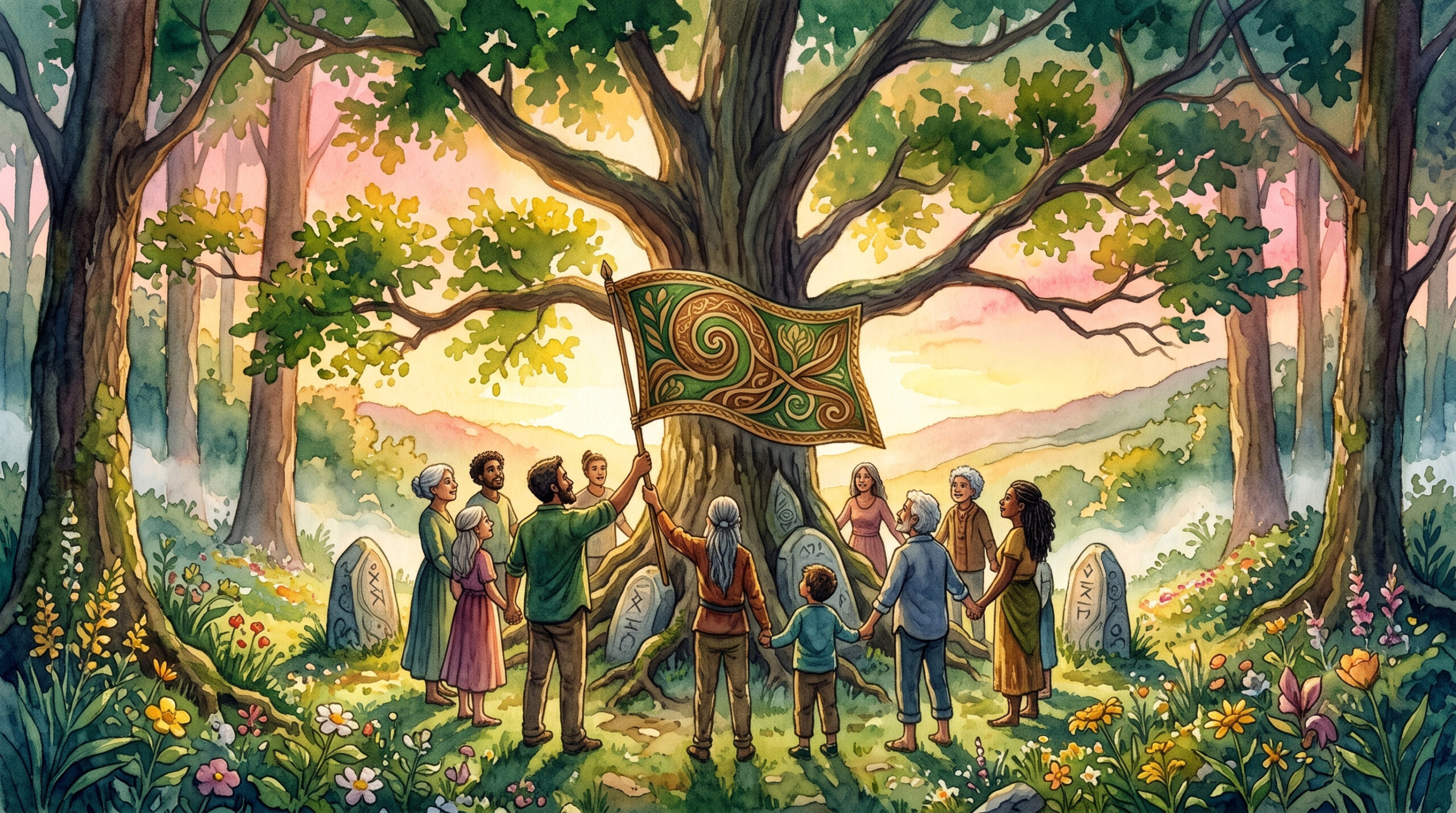
Two hundred and fifty years ago, a group of flawed, complicated radicals sat in a humid room in Philadelphia and did something entirely treasonous: they signed a declaration claiming absolute sovereignty over their own lives, their own fortunes, and their own sacred honor. They drew a hard line of non-encroachment against a distant, dominant tyranny.
Today, as our backyards fill with the scent of charcoal and the concussive boom of fireworks, it is easy to let “Independence Day” dissolve into simple consumerism and passive nostalgia.
But if we look at the state of our world—if we hold up a mirror to the heavy, pressing realities of our current political climate—we quickly realize that independence is not a historical event we inherit. It is a radical, ongoing act of spiritual warfare that we must wage every single day.
As earth-centered practitioners, true patriotism has nothing to do with blind allegiance to a flag or a state. True patriotism is an allegiance to the land itself, to the diverse community that inhabits it, and to the fierce defense of the sovereign spaces we possess.
Continue reading The Radical Act of Independence: Claiming Your Sovereign Landscape

By Katrina Rasbold
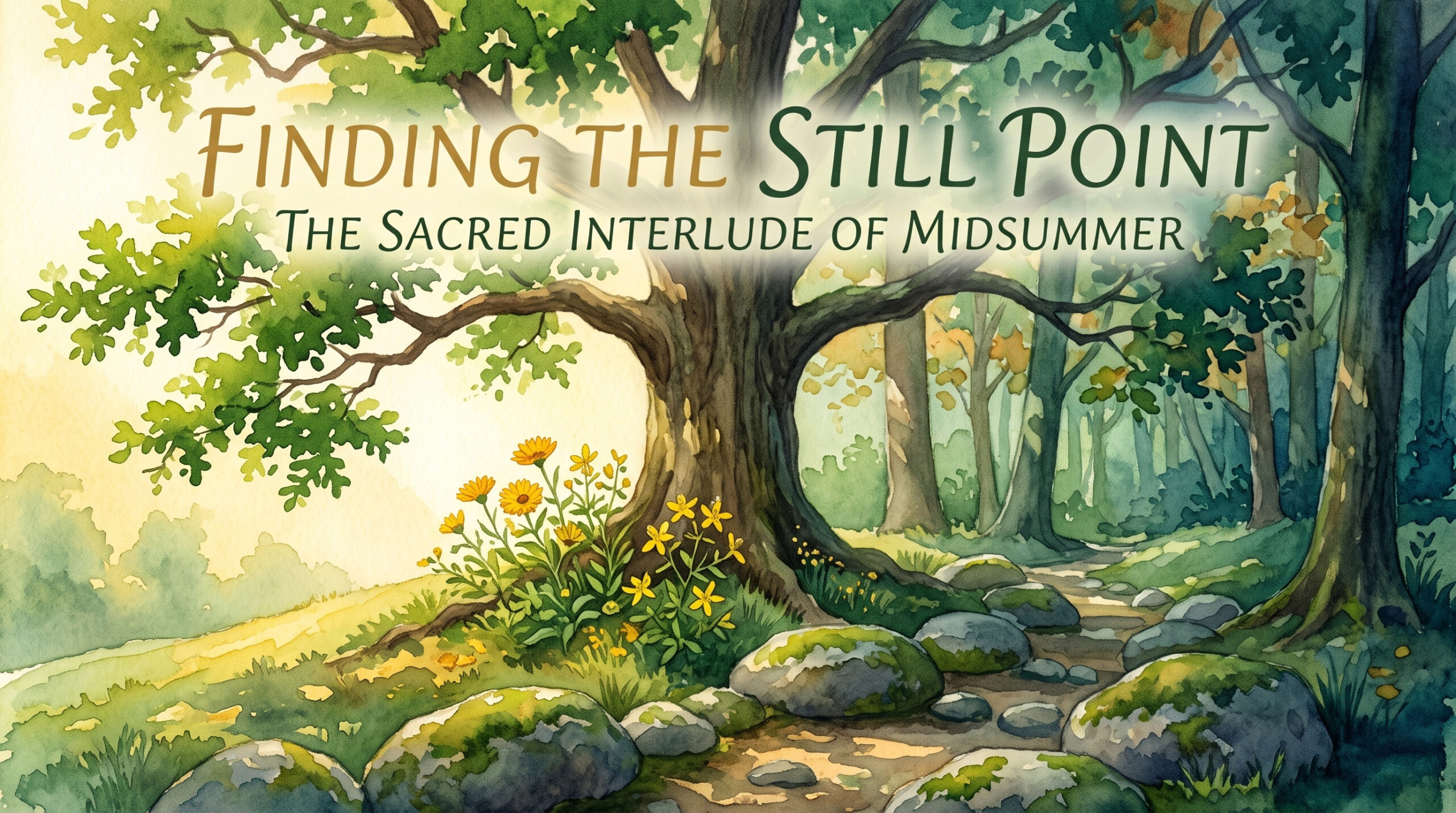
Now that we have officially crested the peak of the Summer Solstice and launched the Summer 2026 issue, a unique energetic shift takes place in the natural world. The frantic, skyward momentum of spring and early summer suddenly slows. The wild weeds have done their rapid climbing, the wild berries are ripening on the vine, and the trees stand in their full, heavy cloaks of deep green. Continue reading Finding the Still Point: The Sacred Interlude of Midsummer

By Katrina Rasbold
Modern Pagans love a clean calendar. We dutifully mark our planners for May 1st, June 21st, or October 31st, preparing our rituals and gathering our supplies to match the rigid grid of the standard solar year. We stress over perfect timing, worrying that if we miss the exact hour of a planetary alignment or a solar peak, the magic won’t quite take root. Continue reading Whose Sabbat Is It Anyway?

By Katrina Rasbold
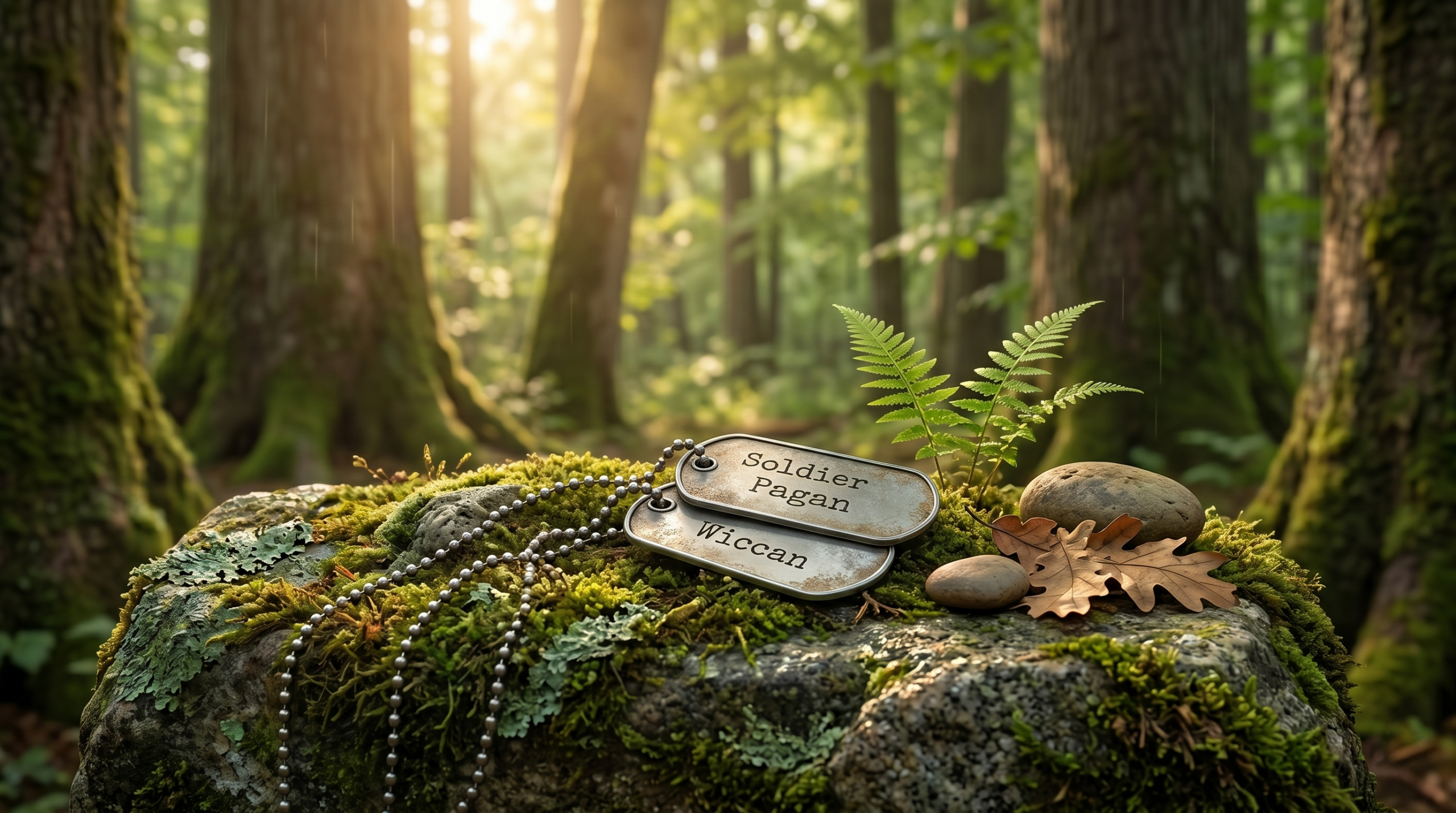
On paper, bureaucracy looks sterile. It moves in the quiet rustle of memos, the dry language of administrative updates, and the clinical scrubbing of data fields. But earlier this week, a pencil stroke at the Pentagon sent a shockwave through the global Pagan community.
The U.S. Department of Defense officially slashed its list of recognized religious affiliation codes from over 200 faith traditions down to just 31.
The administrative axe fell heavily on minority belief systems. In an instant, designations for Pagans, Wiccans, Druids, Heathens, Asatru, Unitarian Universalists, and Humanists ceased to exist in the official military tracking system. In their place, a heavily streamlined list emerged—one where nearly two-thirds of the remaining codes represent specific Christian denominations. Continue reading Ink, Identity, and the Pentagon: Erasing the Minority Faiths