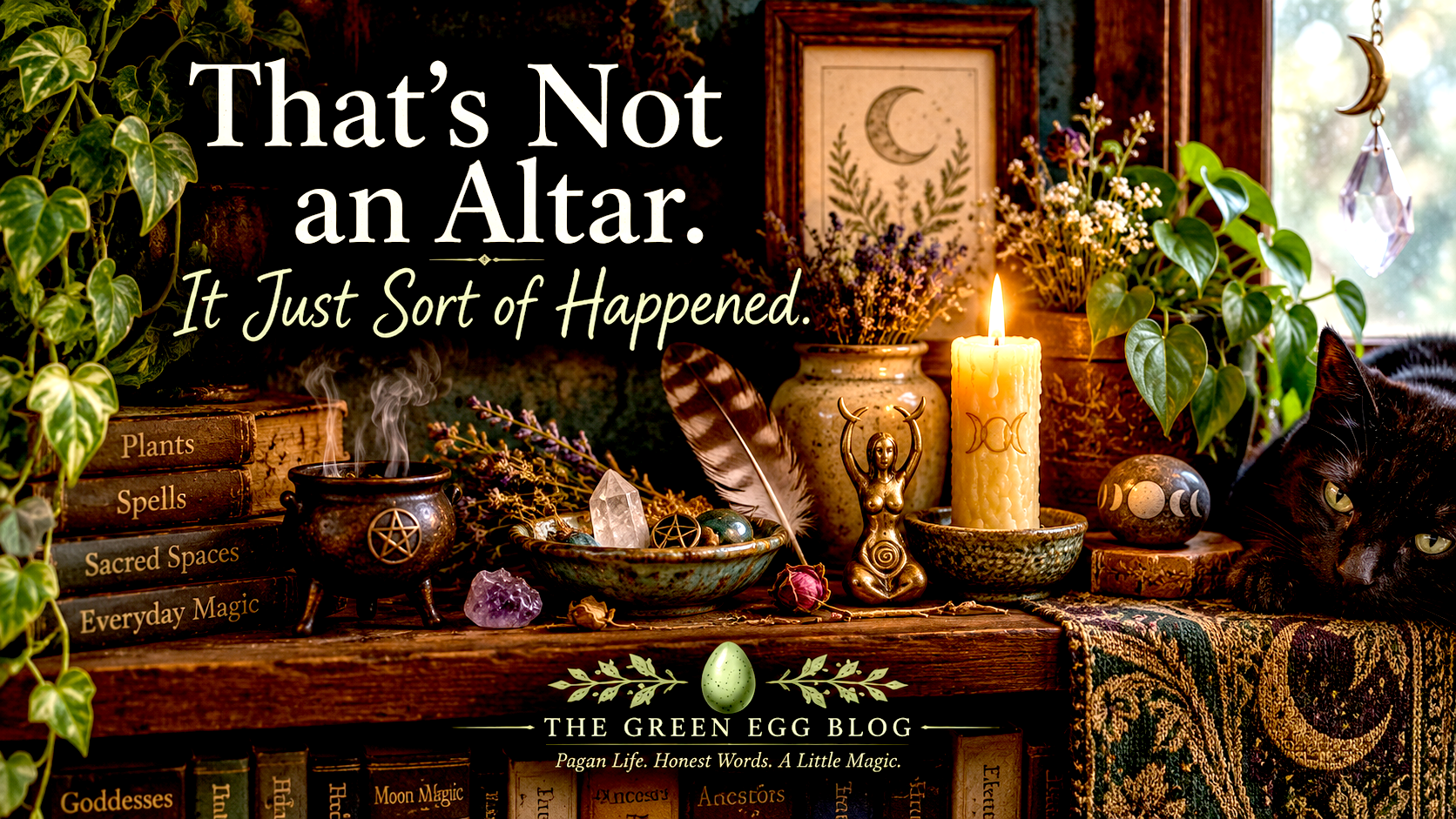
I have built a lot of altars in my life. I know how to do it deliberately. I know how to choose a location, cleanse the space, select the objects, arrange them according to purpose, and create something that clearly announces, This is an altar.
Those aren’t the altars I’m talking about.
I’m talking about the ones that appear when nobody is paying attention.
It begins innocently enough. You find a really good rock, and because we have already established what happens when Pagans encounter really good rocks, the rock comes home with you. You put it on the corner of a bookshelf because that’s as good a place as any.
A few days later, you find a feather.
The feather looks nice next to the rock.
This means nothing, of course.
Then somebody gives you a little dish. It’s too small to be useful for anything normal, but it is exactly the right size to sit beside the rock and feather. You aren’t sure what you’re going to put in it yet. This is also fine.
Eventually a candle appears.
And that’s when things start getting suspicious.
Nobody Planned This
There are altars that begin with intention. We build them for deities, ancestors, seasons, spellwork, meditation, remembrance, protection, devotion, or any of the dozens of other reasons people create sacred spaces. The intention comes first and the objects follow.
The accidental altar works backward.
The objects arrive first.
Perhaps there’s a photograph. A shell from a trip. A dried flower you couldn’t quite bring yourself to throw away. A little statue. Something your child gave you. A stone from a place that mattered. A candle you lit one evening because you wanted the room to feel nicer.
Individually, none of these things necessarily announces itself as sacred.
Collectively, however, they’re starting to organize.
You walk past one day and straighten the feather.
That’s probably the moment it’s over for you.
Because apparently you now care which direction the feather points.
You move the rock slightly to the left. The dish needs to come forward. The candle should really be behind everything because otherwise the proportions are wrong. You stand there for a moment considering the arrangement and then realize what you’re doing.
Oh.
Well.
Apparently we have an altar.
Paganism Has a Way of Spreading
I sometimes think Paganism behaves a little like mint in a garden. You can establish a carefully defined area where you intend it to grow, but eventually you look around and discover it has opinions about those boundaries.
There may be an official altar in the house, beautifully arranged and entirely intentional. That doesn’t stop the windowsill from developing spiritual aspirations.
The kitchen is particularly vulnerable. Herbs already live there, which gives the place an unfair advantage. Add a candle, a little bowl of salt, something growing in a pot, and perhaps an object that has no obvious culinary purpose, and the kitchen starts making a very convincing argument for sacred-space status.
Gardens don’t even try to resist.
Desks can go either way. Mine already spends its days surrounded by the practical machinery of work, but give me enough time and meaningful little objects will begin colonizing the available territory. A stone appears near the computer. Then another. Something protective gets tucked into a corner. A candle moves in.
Eventually there is approximately six square inches left for office supplies.
This is apparently sufficient.
The Difference Between Decoration and an Altar
I’m not entirely sure there is always a difference.
That’s probably heresy somewhere.
Obviously, not every collection of objects is an altar. Sometimes a candle is a candle, a shell is a shell, and a bowl containing rocks is simply evidence that a Pagan lives in the house and cannot be trusted near beaches.
But sometimes an arrangement acquires a kind of gravity.
You notice it.
You interact with it.
Maybe you touch one of the objects when you walk past. Maybe you light the candle when someone you love needs help. Maybe you add something when the season changes. Maybe you stand there for thirty seconds longer than necessary because the things gathered in that little corner remind you of people, places, experiences, or parts of yourself that matter.
Nobody consecrated it.
There was no ritual.
You didn’t declare the bookshelf officially open for sacred business.
It just became a place where meaning accumulated.
I think that counts for something.
The Sacred Has Terrible Boundary Issues
We sometimes talk about sacred space as though it exists because we deliberately separated it from ordinary space. We cast circles. We establish boundaries. We create temples and shrines and altars. We say, in one way or another, this place is different from the place around it.
I understand the value of that. I practice it.
But I also like that the sacred occasionally refuses to stay where I put it.
It sneaks onto windowsills.
It takes over corners of bookshelves.
It settles among houseplants.
It appears beside photographs of people we love and in bowls full of things we picked up while walking somewhere beautiful.
It infiltrates the kitchen and the garden and, if left unsupervised, approximately forty percent of the available horizontal surfaces in a Pagan household.
Maybe that’s because people who practice earth-centered religions are particularly prone to seeing meaning in ordinary things. The stone doesn’t have to stop being a stone. The feather doesn’t have to become something other than a feather. The shell is still just the abandoned architecture of a mollusk.
But we noticed them.
We brought them home.
We placed them beside other things we noticed.
Somewhere along the way, the collection became something more than the sum of its parts.
So no, that’s not an altar.
That’s just a rock, a feather, a candle, a tiny dish, a photograph, three acorns, a shell, a dried flower, and a mysterious key arranged carefully on the corner of the bookshelf.
Please don’t move anything.
I have it exactly the way I want it.
Want to join the conversation about this blog post? Go to the Green Egg Forum and scroll for the forum post that relates to this article
 As Editor of the Green Egg Blog, Katrina Rasbold weaves ancient wisdom into the complexities of modern life, fostering a space for deep inquiry and magical growth. Katrina is the editor of Green Egg Magazine, a priestess, author, and co-creator of the CUSP path, working from the crossroads of tradition and transformation. She owns and operates Crossroads Occult with her husband, Eric, offering a sanctuary for those seeking mentorship, quality handmade magical items, and authentic craft. Discover her full body of work at www.katrinarasbold.com.