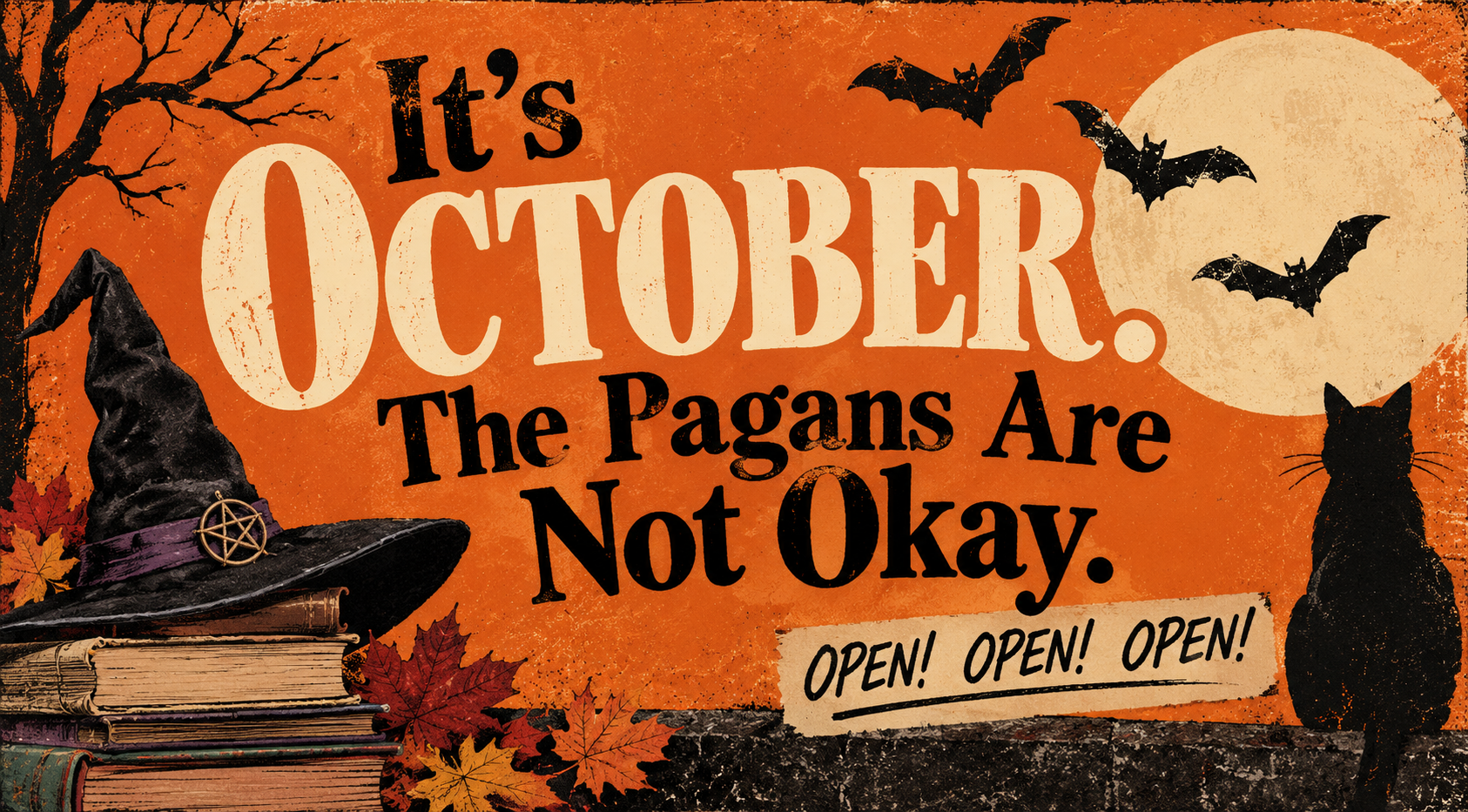
October has arrived and the Pagans are not okay.
To be clear, nothing is wrong. Quite the opposite. We are so ridiculously excited that we’re just barely containing our bodily functions. We’re practically vibrating. We’re breathing heavily in the Halloween aisles, buying things we absolutely do not need, and experiencing a level of seasonal enthusiasm usually reserved for children on the last day of school before winter vacation. If you encounter a Pagan looking slightly unhinged during the first week of October, don’t be alarmed. We’re happy. Possibly too happy. Someone should probably check our blood pressure.
I remember an old television commercial for Mervyn’s department stores featuring a woman standing outside the locked doors, peering through the glass and chanting, “Open, open, open!” with increasing desperation. That’s pretty much what Pagans look like during the final days of September. We know October is coming. We’ve been watching the calendar. We’ve been behaving ourselves, more or less, throughout the preceding months, but by September 29th, we’re metaphorically pressed against the glass, waiting for someone to unlock the doors.
OPEN. OPEN. OPEN.
And then midnight arrives, the calendar turns, and somewhere in the distance, thousands of Witches simultaneously begin cackling.
It’s Home Furnishing Month
For eleven months of the year, finding appropriate home decorations can require some effort. Certainly, we have our favorite shops and online suppliers, and a determined Pagan can acquire a pentacle wall hanging in February if sufficiently motivated. But October is different. October is when perfectly ordinary retail establishments suddenly become metaphysical supply stores.
Skulls! Ravens! Cauldrons! Brooms! Black candles! Moon decorations! Skeleton hands holding little dishes! Apothecary bottles with labels suggesting contents that would get the manufacturer arrested if they were accurate!
It’s glorious.
Other people are shopping for Halloween decorations. We’re shopping for things we intend to display in our home until we die.
The seasonal home décor aisle becomes an exercise in restraint, especially when we encounter an object that is both completely unnecessary and absolutely essential to our continued happiness. Do I need another decorative raven? Probably not. Do I already have a perfectly respectable collection of ravens? Almost certainly. Is this one slightly different from the others? Well, obviously, it’s coming home. Why? Because for eleven months, we are surrounded by cottagecore geese, houses, and picket fences. For one month a year, an aisle or two in stores across the nation become our home furnishing wonderland.
There is also the peculiar satisfaction of seeing mainstream retailers enthusiastically embrace an aesthetic that, for the rest of the year, occasionally causes visitors to ask whether we’re planning a séance. Suddenly the skull on the mantel is festive. The broom beside the door is charming. The black candles are atmospheric. The little cemetery in the front yard is evidence of community spirit.
For one glorious month, our houses look completely normal. Everybody else’s houses finally look weird enough to match. “Wow! You went all out decorating for Halloween! How festive!”
“Uh… yeah.”
No, This Is Not a Costume
October also presents an interesting wardrobe problem.
You can spend the entire year wearing flowing black clothing, dramatic jewelry, boots, velvet, long skirts, pentacles, and whatever else happens to appeal to your personal sense of style. Most people will simply regard you as eccentric, artistic, or perhaps someone who never got over particularly meaningful relationship with Stevie Nicks during adolescence.
But in October, the questions begin.
“Oh! Are you dressed up for Halloween?”
No.
“Are you going to a costume party?”
No.
“Who are you supposed to be?”
Me.
There is something wonderfully disorienting about being asked whether you’re wearing a Witch costume when you’re simply wearing the same clothes you wore to the grocery store in July.
And if you actually do dress up for Halloween, the situation becomes even more confusing. What does a Witch dress up as for Halloween? Another Witch? A more elaborate Witch? A Witch with better accessories? Personally, I think there’s an argument for dressing as an accountant, just to see whether anybody notices.
Of course, there are plenty of Pagans whose everyday clothing is indistinguishable from anyone else’s. October doesn’t require a uniform. But for those of us who have spent decades cultivating a certain aesthetic, the sudden popularity of our ordinary wardrobe is deeply entertaining.
Apparently, we’re fashionable for thirty-one days. We should enjoy it while it lasts.
The Annual Witch Interview Season
October is also the month when the mainstream world remembers that actual Witches exist.
For most of the year, we go about our lives relatively unnoticed. We work, raise families, pay bills, maintain households, practice our spiritual traditions, and do all the other things human beings do. Some of us write books, teach classes, provide spiritual services, or participate in Pagan communities, but the general public isn’t especially interested in interviewing us about any of that in March.
Then October arrives. Suddenly somebody needs a Witch. They haul out our old rattling bones for a dog and pony show.
The goal is for us to explain Samhain in ninety seconds, describe what modern Witches believe, clarify whether we worship Satan, and perhaps demonstrate something visually interesting before the commercial break.
There is a particular expression that develops on the faces of experienced Pagan interviewees when someone asks, for the four-hundredth time, whether Halloween is our most important holiday and whether we sacrifice animals. We smile and slightly tilt our head to appear adorable. We explain. We attempt to provide accurate historical and religious context while someone in the production department wonders whether they can put a bubbling cauldron in the background.
Sometimes the resulting interview is thoughtful and respectful. Sometimes it’s perfectly dreadful. Most often, it’s somewhere in between, and we do our best because public understanding of Paganism matters, even when the opportunity arrives wrapped in plastic spiderwebs.
Then November comes, and we return to being mysterious background characters until next October. Unless somebody needs a Witch for a story about Friday the 13th.
The Candy Situation
We should probably discuss the candy.
Halloween candy enters Pagan households through the same channels as everyone else’s. We purchase it for trick-or-treaters, receive it from well-meaning relatives, or acquire it under the perfectly reasonable pretense that we should have something available for neighborhood children.
What happens afterward is less easily explained.
There is a mysterious phenomenon in which the candy supply begins diminishing before Halloween even arrives. A bag purchased on October 10th may require replacement by October 20th, despite the fact that not a single trick-or-treater has approached the door.
Clearly, supernatural forces are involved.
The situation becomes even more mysterious after Halloween, when children discover that the contents of their carefully collected candy stashes have begun decreasing overnight. Certain varieties seem particularly vulnerable. Chocolate disappears at an alarming rate, while those unfortunate candies nobody really likes remain untouched. I told my kids that they were terrible children and Baba Yaga took their candy while they slept to punish them. They should go to their room and think about what they’ve done. And leave the candy bag here. I’ll guard it.
Or it could be the fairies. The fairies are the obvious suspects.
Or that spooky-ass Elf on a shelf. We know he’s up to no good.
At this point, we need a line-up that includes Keyser Söze.
You know… we should probably leave them an offering. They appreciate peanut butter and chocolate. Caramel and peanuts are also acceptable. For the best results, offer up the finest items in your bag. Appease the gods. Sacrifice for a greater good. Your selfishness will damn us all.
Samhain Is Actually Serious Business
Underneath all this ridiculousness, October really does matter to many Pagans. Samhain is a significant observance in numerous Pagan traditions, and for those who honor it, the season can bring an intensified awareness of ancestry, mortality, remembrance, transition, and our relationships with the dead. The turning of the year carries meaning beyond the arrival of pumpkin-shaped merchandise.
I have participated in Samhain observances that were solemn, deeply moving, and profoundly spiritual. I have stood in ritual spaces where the presence of those who came before us felt close enough to touch. I’ve remembered beloved dead, contemplated the passing of another year, and experienced the particular emotional weight that this season can carry.
None of that prevents me from becoming ridiculously excited when I see a really good decorative skull.
This is something I love about Paganism. We can hold reverence and irreverence in the same hands. We can approach the mysteries of death and remembrance with genuine devotion while also appreciating a skeleton wearing sunglasses in somebody’s front yard. We can honor our ancestors, prepare meaningful rituals, contemplate the cycles of nature, and still become completely unreasonable about a twelve-foot plastic skeleton at Home Depot.
Sacredness and silliness are not mutually exclusive. Frankly, I suspect some of our ancestors would be delighted by the candy.
The Most Wonderful Time of the Year
By the middle of October, we’re generally in our element. The weather is changing, at least in places where the weather has received the appropriate seasonal instructions. The evenings arrive earlier. Autumn colors begin appearing. Seasonal foods return. Candles seem particularly appropriate, and the world becomes temporarily populated with bats, ravens, moons, ghosts, witches, and assorted representations of death that would look perfectly at home in our living rooms.
People who ordinarily wouldn’t consider entering a metaphysical shop are buying crystals, Tarot-themed decorations, spell bottles, and little ceramic cauldrons. Children are running around dressed as witches and wizards. Neighborhoods are full of pumpkins. For a few weeks, the imagery of magic is everywhere.
Of course, most of the people enjoying these things aren’t practicing Pagans, and that’s perfectly fine. Halloween is a secular celebration for many, a religious observance for others, and a complicated mixture of traditions, history, commerce, and personal meaning for almost everyone.
We don’t own October. We should.
But I think we can be forgiven for feeling especially at home in it.
After all, we’ve spent the other eleven months explaining that the skulls are permanent decorations, the black clothing is not a costume, the broom is not a prop, and yes, we really do celebrate Samhain. Now the rest of the world has joined us, at least aesthetically, and we’re delighted to have the company.
So if you happen to encounter a Pagan standing motionless in the Halloween aisle, breathing a little too heavily while staring at a particularly magnificent cauldron, don’t be alarmed.
We’re fine.
We are not having a petit mal seizure.
Probably.
We’ve just found something we absolutely do not need.
And we’re by Goddess going to buy it anyway.
Happy October, everybody.
OPEN. OPEN. OPEN.
Want to join the conversation about this blog post? Go to the Green Egg Forum and scroll for the forum post that relates to this article
 As Editor of the Green Egg Blog, Katrina Rasbold weaves ancient wisdom into the complexities of modern life, fostering a space for deep inquiry and magical growth. Katrina is the editor of Green Egg Magazine, a priestess, author, and co-creator of the CUSP path, working from the crossroads of tradition and transformation. She owns and operates Crossroads Occult with her husband, Eric, offering a sanctuary for those seeking mentorship, quality handmade magical items, and authentic craft. Discover her full body of work at www.katrinarasbold.com.