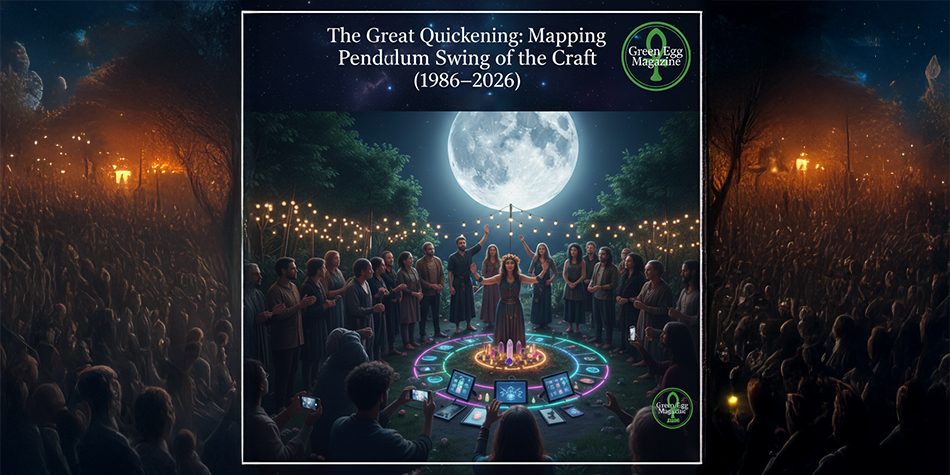
By Katrina Rasbold
40 Years – Gone in the blink of an eye.
To flip through the yellowed, newsprint pages of a 1980s Green Egg is to touch a different dimension. In those days, the ink came off on your fingers, and the ideas—bold, radical, and often dangerously counter-cultural—felt like they could set the paper on fire. We were a tribe of correspondences, P.O. Boxes, and wilderness gatherings where the drums beat against a silence that the modern world has all but forgotten.
Of course, Green Egg Magazine goes back to the 1960, so tack on an additional two decades. I threw a dart into the 1980s because that is when I came to the Craft and subsequently, to Green Egg Magazine.
Today, the “Old Religion” has entered the “New Information Age.” As we stand in 2026, the contrast between the Paganism of forty years ago and the Paganism of today is not just a shift in fashion; it is a fundamental evolution of how the human spirit interfaces with the Divine.
The Age of the Sacred Scarcity (The Mid-80s to Late-90s)
In 1986, being a Pagan was a logistical challenge. It was an era of information scarcity. If you lived in a rural town and felt the pull of the Moon, you were essentially an island. You kept your practice secret on secret on secret and you had access to only limited information on how to be a Pagan, a Witch, or a magical practitioner. If happened upon a practicing coven, you’d found the unicorn… not one of Oberon and Morning Glory’s, but the metaphoric unicorn of something rare and extremely special.
If your magical fields were depressingly unicorn-free, you had to really want to pursue the Craft and work hard to find information, much less support. The “Seeker’s Journey” back then was a literal one. It involved driving to distant occult shops, the “occult” section of the library (which was usually just two books by Sybil Leek and a dusty copy of The Golden Bough), and the agonizing wait for a SASE (Self-Addressed Stamped Envelope) to return from a coven leader three states away.
That is why publications such as Green Egg Magazine were so vital. They created community where none existed.
The Sacredness of the Scarcity
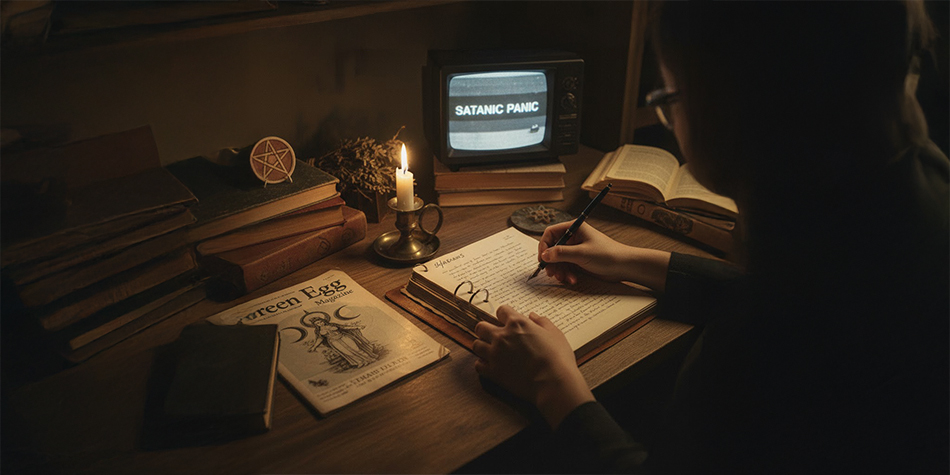
Because information was hard to find, it was treated as holy. When you finally laid hands on a photocopied “Book of Shadows,” you didn’t just read it; you transcribed it by hand. This act of transcription served as a powerful and deeply spiritual meditation, a slow-burn initiation.
If 1986 me saw the magical library of 2026 me, she would be unable to form words. I now likely own more magical books than were in print in 1986 and that is after my house burned down in 2022, taking my even more massive library into the flames.
Community, too, was a high-stakes game. The “Broom Closet” wasn’t a metaphor; it was a necessity. In the shadow of the Satanic Panic—a cultural hysteria that conflated Goddess worship with dark conspiracies—Paganism was a subversive act. Meeting in a park for a Sabbat carried a genuine thrill of rebellion. We were the “Hidden Children,” and our secrecy forged a bond of iron. We knew each other’s faces, the smell of each other’s specific incense blends, and the sound of each other’s voices, but we might not know each other’s “real” names. There were no “unmuted” mics; there was only the circle.
The Digital Quickening (The 2000s to 2015)
The turn of the millennium acted as a bridge. The rise of the internet—from the early BBS boards to the “Witchy LiveJournal” era—began to dissolve the geographic isolation of the solitary practitioner. My portal was a message board called “The Inner Sanctum.” We connected with Pagans from all over the world and spent many hours – some of them heated – contrasting and comparing our practices and often arguing over Unverified Personal Gnoses. Who was right and who was wrong became quite important.
Suddenly, the “Hidden Children” had a digital playground. This was the era of the Great Pagan Democratization. The walls of lineage and the gatekeeping of high-degree initiations began to crumble. While many elders feared the dilution of the Craft, the influx of new blood brought an explosion of scholarship. We saw the rise of “History-Based” Heathenry and the rigorous reconstruction of Hellenic and Roman paths. We were no longer just making it up as we went along or taking someone’s word for what was “real” Witchcraft or Paganism and what was inauthentic; we were digging into the dirt of history with digital shovels.
The Technicolor Renaissance (2016–2026)
Fast forward to the present. If 1986 was a flickering candle in a dark wood, 2026 is a neon-lit cathedral. Paganism has moved from the “fringes” to the “feed.”
The Aesthetic Revolution
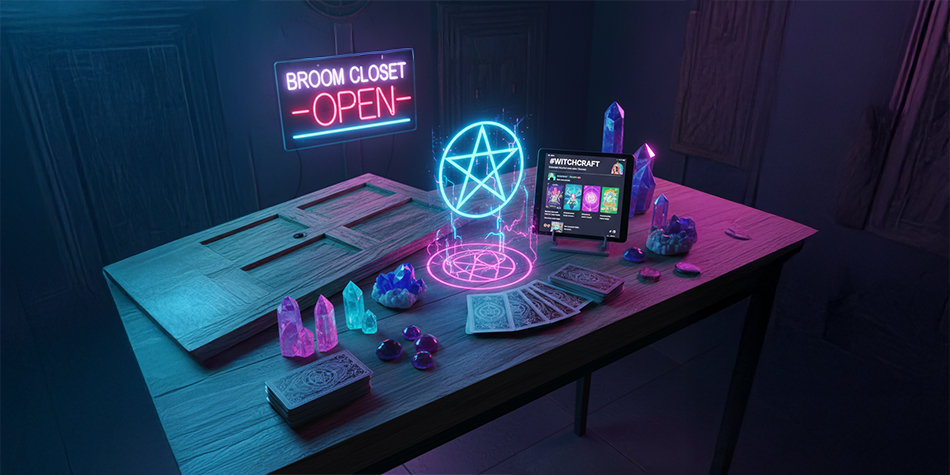
We cannot discuss modern Paganism without addressing the “Instagrammability” of the Craft. In 2026, the visual language of magic is everywhere. Crystals are a multi-billion-dollar industry; Tarot decks are sold alongside high-end fashion; and “Witchcraft” is a trending hashtag with billions of views.
For the old-guard practitioner, this can feel like a betrayal—a commodification of the sacred. But there is a flip side. The ubiquity of Pagan imagery has decimated the “Satanic Panic” stigmas of the past. A teenager today can wear a pentacle to school without the local clergy calling for an exorcism. The “Broom Closet” doors haven’t just been opened; they’ve been taken off the hinges and repurposed into reclaimed wooden altars.
The Rise of the Algorithmic Coven
Community today is decentralized. While physical covens still exist, the majority of Pagans now find their “tribe” through algorithms. Where we used to seek out community and faith-based connection with a sort of desperation, now there is a trend toward solitary practice.
The now easy access to seemingly endless information (and opinions) has led to an incredible hyper-specialization. In the 80s, you were likely a “Wiccan” because that was the only label available. Today, you can be a “Secular Green Witch with an interest in Baltic Folklore and Solarpunk Ethics.” The menu of spiritual identity is infinite. This allows for a deeply personalized path, but it lacks the friction of the physical circle—the “polishing of the stone” that happens when you have to work through a ritual with people you don’t actually like, but whom you love as kin.
Comparing the Core Pillars
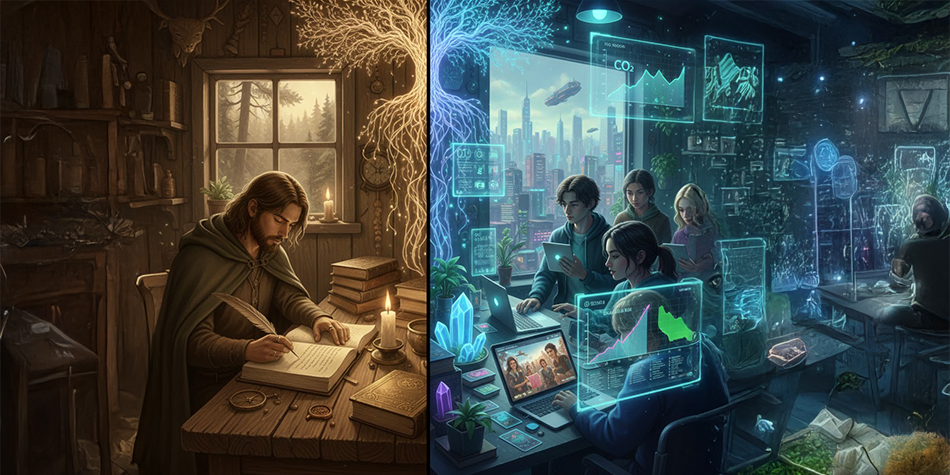
To understand the distance we’ve traveled, we must look at the three pillars of the Path: Knowledge, Nature, and Community.
Knowledge: From Transcription to Consumption
-
Then: Knowledge was an Achievement. You earned it through service, study, and the physical tracking down of mentors. We earned our transition through levels or degrees which were ritualized and celebrated with our covenmates.
-
Now: Knowledge is a Commodity. It is instant, abundant, and often overwhelming. The modern challenge isn’t finding the truth; it’s discerning it from the noise. While the accessibility to knowledge is infinite, the definition of authentic truth remains as elusive as it did when we had to go to heroic measures to find other practitioners.
Nature: From Emergence to Emergency
-
Then: Nature was a Sanctuary. We went to the woods to escape the “machine” of the mundane world. It was a romantic, pastoral relationship that brought us closer to our Gods. Nature was the sacred “church” where we connected with Gaia and felt our oneness with both the “above” and the “below.”
-
Now: Nature is an Emergency. For the modern Pagan, the Earth is not just a beautiful backdrop for a ritual; it is a dying patient. Our magic has become more activist, more urgent, and more focused on “Animist Realism”—the realization that we are part of a biological system in crisis. We now live in a world with more concrete and cement than we had forty years ago. Thankfully, there is still more “green and blue” than “gray,” although it might seem to not be the case since more than 80% of Americans live in urbanized areas. For many, finding a Crossroads where they can work their magic or a forest where they can worship their God/Goddess involves as much seeking as those 1980s Pagans did to find one another.
Community: From the Hearth to the Cloud
-
Then: Community was Local and Limiting. You were stuck with who was in your zip code, for better or worse. You drove long distances to spend time in candle shops or “head shops” that happened to carry Tarot cards. You communicated with other practitioners through snail mail or by telephone and back then, you paid a premium for long-distance phone calls.
-
Now: Community is Global and Liquid. You can find a “Tradition” that perfectly matches your soul, but you might never hold the hand of your Coven mate during a chant. I am curious to know what percentages of practicing Pagans have walked never into a circle lit by torches (with real fire, not solar lights), the aroma of incense hanging in the air, the heartbeat of a drum percussing from somewhere in the darkness, a fire crackling in a cauldron or firepit, a slight chill in the air as people pulled their cloaks a bit closer to them, and the thrum of energy coursing from person to person.
The Synthesis: What Was Lost, What Was Won
Have we lost the “Mystery”? That is the question whispered at the back of many modern festivals. When you can buy a “Ritual-in-a-Box” for $29.99, does the spirit still show up? Is the novelty of a festival attended by a few thousands of Pagans as impressive now when you can encounter even more just by logging onto TikTok?
The answer, as any elder of the Green Egg lineage will tell you, is that the Gods don’t care about our technology. They care about our intention, our veneration, and the fact that we show up, regardless of the form that takes.
What was lost:
- The sense of “The Ordeal.”
- The slow, quiet, agonizing development of a magical persona over years of silence.
- The deep, physical connection to a specific plot of land that you have tended for decades.
Those of us who were there may lament those times the loss of those times, but we have the distinction of being there for the advent of Paganism becoming (almost) mainstream. It is reasonable to imagine that unique moment will never happen again and we were there for it.
What was won:
- Inclusion
In 1986, if you were disabled, neurodivergent, or living in a country where Paganism was illegal, you were often excluded from the circle. Today, the digital space has made the Craft accessible to everyone. We have become a more diverse, vibrant, and intellectually robust community.
Although many groups were Goddess-venerating and female-forward, this rarely presented as “sovereignty” and was more often coded as objectification. Paganism has historically used the “inclusion” stone as a major load-bearing structure of its foundation and that position has evolved exponentially in the past four decades. As America became more educated and accepting of the LGBTQ+ community, the neurodiverse, and the ethnically diverse, Paganism led the way by modeling the behavior they wanted to see in the world.
Looking Forward: The Emerging Pagan
As we look toward the next forty years, the pendulum continues to swing. We see a move away from the “Aesthetic Witch” and back toward the “Village Healer.” There is a growing hunger for authenticity—a move toward growing one’s own herbs, making one’s own tools, and unplugging from the digital “Outer Court” to find the “Inner Sanctum” once more.
The Pagan of 2026 is a synthesis. They have the high-tech tools of the future in one hand and a handful of ancestral soil in the other. They are using AI to translate ancient Sumerian tablets while simultaneously learning how to forage for mushrooms in their local park.
The Unchanging Flame
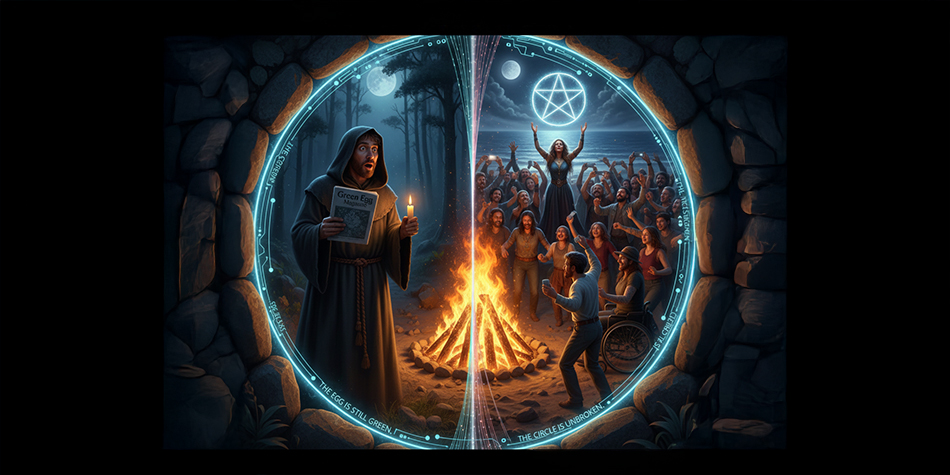
If we could bring a seeker from 1986 into a ritual in 2026, they would be baffled by the iPhones recording the bonfire and snapping pictures of the altars. They would be shocked by the lack of secrecy and surprised by the openness.
But as the drums began to beat, and the Priestess called the Quarters, and that familiar, electric hum began to fill the air—the “vibe” that tells us the veil is thinning—that seeker would recognize exactly, precisely, and without hesitation where they were.
The tools change, the terminology evolves, and the magazines move from newsprint to pixels, but the Great Work remains the same: to wake up, to remember our kinship with the stars and the stones, and to dance under the moon and stars, before water and flame, while we are here.
The Egg is still green, the Goddess is still calling, and the circle, though it now spans the globe through fiber-optic cables, remains unbroken.
 Katrina Rasbold is a professional Witch, published author, priestess, and editor of Green Egg Magazine. She and her husband, Eric, are the creators of the CUSP spiritual path and owners of Crossroads Occult. You can reach her and access her Patreon with deeper classes and mentorship through www.katrinarasbold.com.
Want to join the conversation about this blog post? Go to the Green Egg Forum and scroll for the forum post that relates to this article: https://www.facebook.com/groups/1069823176940972