By Katrina Rasbold
I was looking for one particular candle the other day.
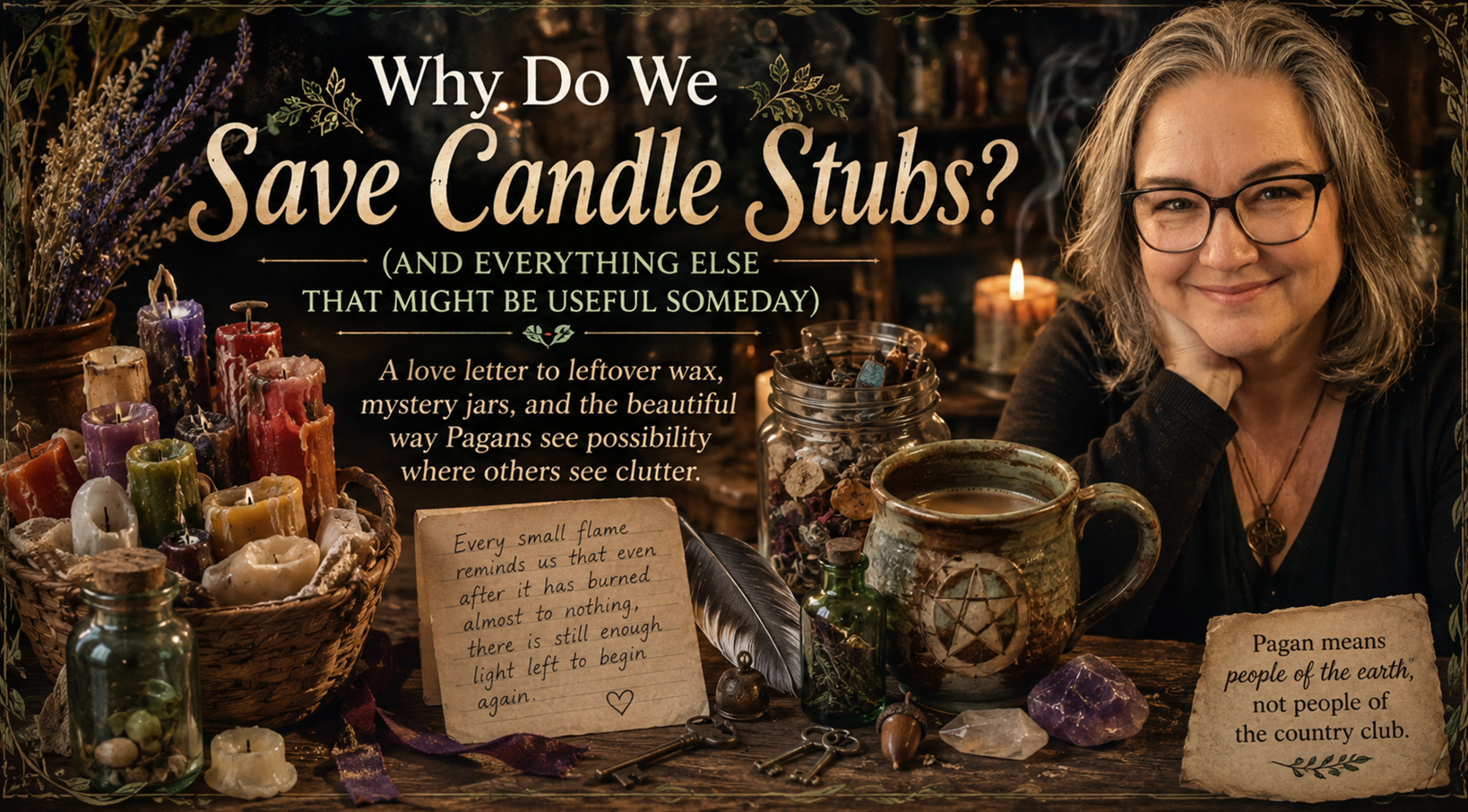
Not a fancy one. Not the expensive beeswax pillar I’d been saving for some future occasion worthy of its existence. I was looking for a little red candle that had already done its job. It had burned down to a crooked little nub, with barely enough wax left to stand on its own.
Naturally, I couldn’t find it.
What I could find was an entire box of other candle stubs.
White ones.
Blue ones.
Green ones that had somehow adopted enough cat hair to qualify as a new species.
Half a cinnamon stick.
A ribbon that once tied something important.
A tiny bell.
Three feathers.
An acorn.
And a key that, as far as I know, has never opened anything in this century.
I suspect I’m not alone.
Every Pagan I know has a box, a drawer, a basket, or an old cookie tin that serves as a retirement community for magical odds and ends. Things that are too useful to throw away but too mysterious to organize. Objects that whisper, “You might need me someday.”
It’s easy to laugh about it because, frankly, it’s funny.
But I’ve started wondering if our little collections say something about us.
Part of it is practical. Paganism has never exactly been the religion of luxury shopping. The very word pagan comes from people of the countryside—people of the fields and forests—not people of the country club. Ours is a path that has long celebrated making do, repurposing, and finding the sacred in ordinary things.
A candle that still has an inch of wax left isn’t “used up.” It’s another spell waiting to happen.
An old jar isn’t trash. It’s future storage.
A ribbon from a meaningful gift isn’t clutter. It’s a memory that still has work to do.
For many of us, that habit also comes from lived experience. There have been seasons when buying new tools wasn’t an option, so we learned to look at what we already had with more creative eyes. It’s amazing how resourceful a person becomes when necessity is invited into the ritual circle.
And then there’s another possibility.
Our community has always seemed to make room for people who experience the world a little differently. Whether someone is neurodivergent, intensely sentimental, wonderfully detail-oriented, or simply inclined to see stories where other people see “stuff,” many of us form relationships with objects that don’t make much sense to anyone else.
That feather isn’t just a feather.
That tiny bottle isn’t just a bottle.
That candle stub isn’t just leftover wax.
Each one carries a memory, a possibility, or a feeling that refuses to fit on a label.
Perhaps that’s why it’s so difficult to throw them away. We’d like to believe we’re saving supplies for another ritual, but sometimes I think we’re really saving little pieces of our own story.
Of course, there are limits.
Every once in a while, we have to admit that the herb we bought during the Clinton administration is probably past its prime. The mystery cord that has survived four moves without revealing its purpose may be ready for honorable retirement. And if you have seventeen empty jars but can’t find a clean drinking glass, it may be time for a conversation with yourself.
I’m not judging.
I’m writing this while glancing nervously toward my own basket of “perfectly good things.”
Still, I hope we never lose that instinct entirely.
In a world that encourages us to throw away, replace, upgrade, and move on, Pagans have always had a knack for seeing possibility in what remains.
Maybe that’s why we save candle stubs.
Not because we’re unwilling to let go.
Because every small flame reminds us that even after it has burned almost to nothing, there is still enough light left to begin again.
Want to join the conversation about this blog post? Go to the Green Egg Forum and scroll for the forum post that relates to this article
 As Editor of the Green Egg Blog, Katrina Rasbold weaves ancient wisdom into the complexities of modern life, fostering a space for deep inquiry and magical growth. Katrina is the editor of Green Egg Magazine, a priestess, author, and co-creator of the CUSP path, working from the crossroads of tradition and transformation. She owns and operates Crossroads Occult with her husband, Eric, offering a sanctuary for those seeking mentorship, quality handmade magical items, and authentic craft. Discover her full body of work at www.katrinarasbold.com.