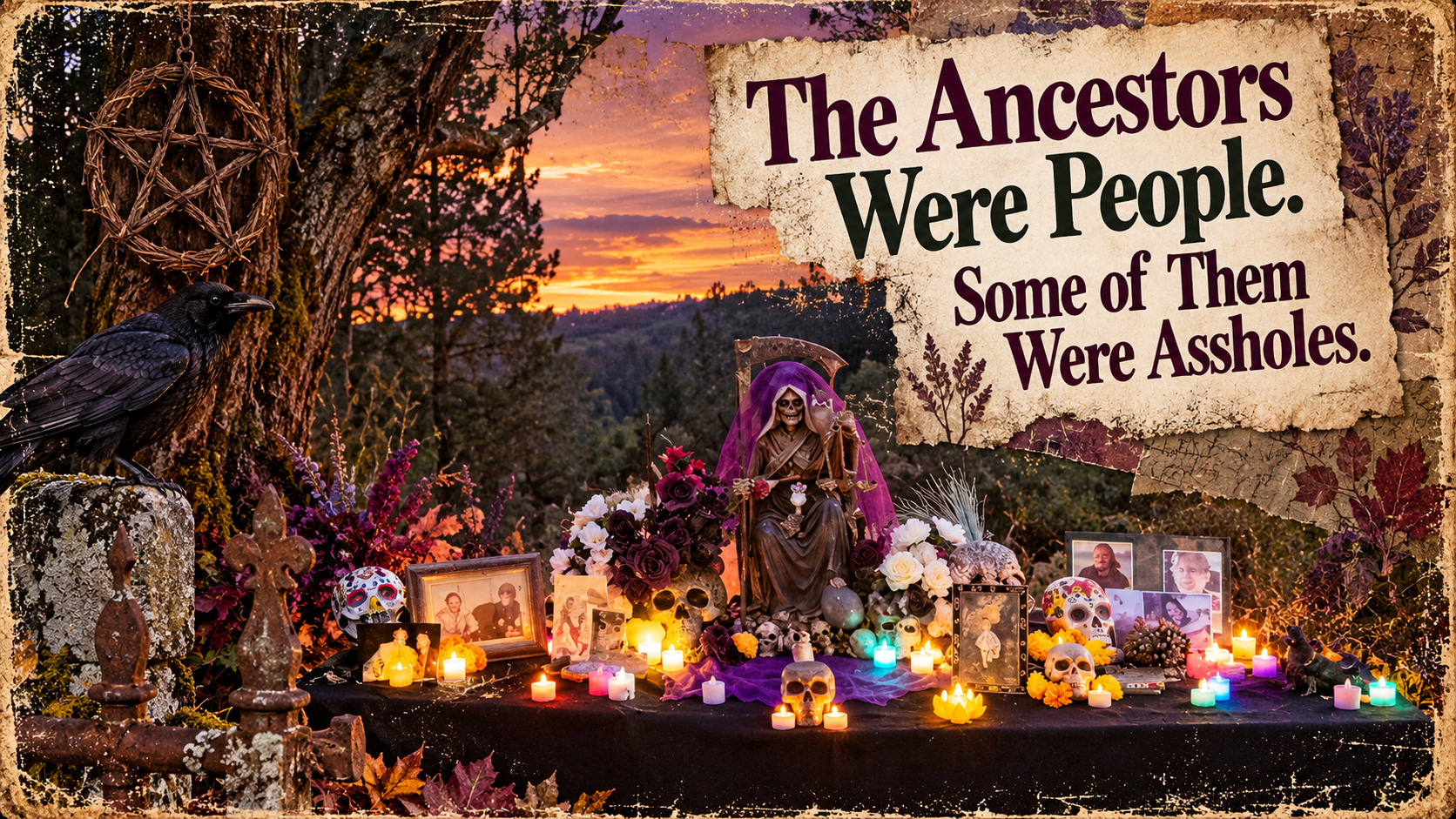
Every year as Samhain approaches, Pagans begin talking about honoring the ancestors. The veil grows thin, the beloved dead draw near, and we prepare our altars with photographs, candles, flowers, offerings, and other reminders of those who have gone before us.
It’s a beautiful tradition, and one I have practiced for decades. There is something profoundly moving about setting aside time to acknowledge the people whose lives touched ours, whose blood runs through our veins, or whose influence helped shape the people we became.
There is also something about the approach of Samhain that seems to convince people that everyone who has ever died has become wise, benevolent, and deeply interested in helping us navigate our lives.
I have some reservations about that.
The ancestors were people. Some of them were extraordinary people. Some were loving, generous, courageous, and remarkably wise. Others were stubborn, selfish, dishonest, manipulative, or just generally unpleasant to be around.
Some of them were assholes.
And as far as my experience has shown me, dying does not automatically cure that condition.
Death Is Not a Personality Transplant
One of the more interesting things I’ve observed through decades of spiritual practice is that the transition from physical life to spirit existence can change people, sometimes considerably. I believe that many of the limitations and burdens imposed by the physical body fall away after death, and that can have a profound effect on how someone experiences themselves and interacts with others.
Consider someone who spent the last twenty years of life in chronic, debilitating pain. Pain changes people. It affects patience, temperament, concentration, emotional resilience, and the ability to engage comfortably with the world. A person who was once cheerful and affectionate may become withdrawn, irritable, or difficult because every waking moment involves suffering.
The same can be true of people living with severe neurological conditions, paralysis, amputations, extreme obesity, or other physical circumstances that profoundly affect their daily experience. Addiction can also alter behavior and relationships in ways that may not reflect the whole of the person beneath the struggle.
In my understanding and experience of spirit communication, release from those conditions can produce meaningful changes. Someone who was miserable in the final years of life may seem lighter, happier, and more like the person they were before illness or suffering took such a terrible toll.
That makes sense to me. If a significant source of someone’s distress is gone, why wouldn’t that change how they experience themselves?
But there is a difference between someone whose behavior was affected by suffering and someone who was consistently cruel, manipulative, dishonest, or abusive.
I have not found that crossing over automatically transforms the latter into a kindly spiritual adviser.
If Uncle Harold was an opinionated jackass when he was alive, I would not assume that death has suddenly made him a delightful conversationalist with profound insights into the mysteries of existence.
He may simply be an opinionated jackass who no longer needs reading glasses.
Honoring Someone Is Not the Same as Trusting Them
When people ask me about communicating with deceased relatives, I often give them a piece of advice that may not sound particularly mystical:
If you wouldn’t take advice from them or trust them when they were alive, don’t imagine you should when they are dead.
I think that’s an important distinction, especially at Samhain, when ancestor veneration becomes such a prominent subject in Pagan communities.
We can honor the place someone occupied in our family history without pretending they were a wonderful person. We can acknowledge that our ancestors survived hardships, made sacrifices, and contributed to the chain of events that eventually produced us without agreeing with their values or admiring their behavior.
We can even feel gratitude toward someone for certain things while remaining clear-eyed about the harm they caused.
And sometimes the most appropriate relationship with a deceased relative is no relationship at all.
Not everyone comes from a loving family. Some people have histories of abuse, abandonment, cruelty, or profound dysfunction. The suggestion that they should welcome those same individuals into their spiritual lives simply because Samhain has arrived can be deeply misguided.
Blood relationship is not an automatic invitation to spiritual intimacy.
Neither is death.
For that matter, I don’t believe our beloved dead must be related to us by blood. Some of the most important people in our lives are friends, mentors, teachers, partners, and members of the families we create for ourselves. Their influence can be every bit as significant as that of someone whose name appears on our family tree.
The people we choose to remember and honor deserve a place alongside those from whom we descend.
The Dead Don’t Require Perfect Table Settings
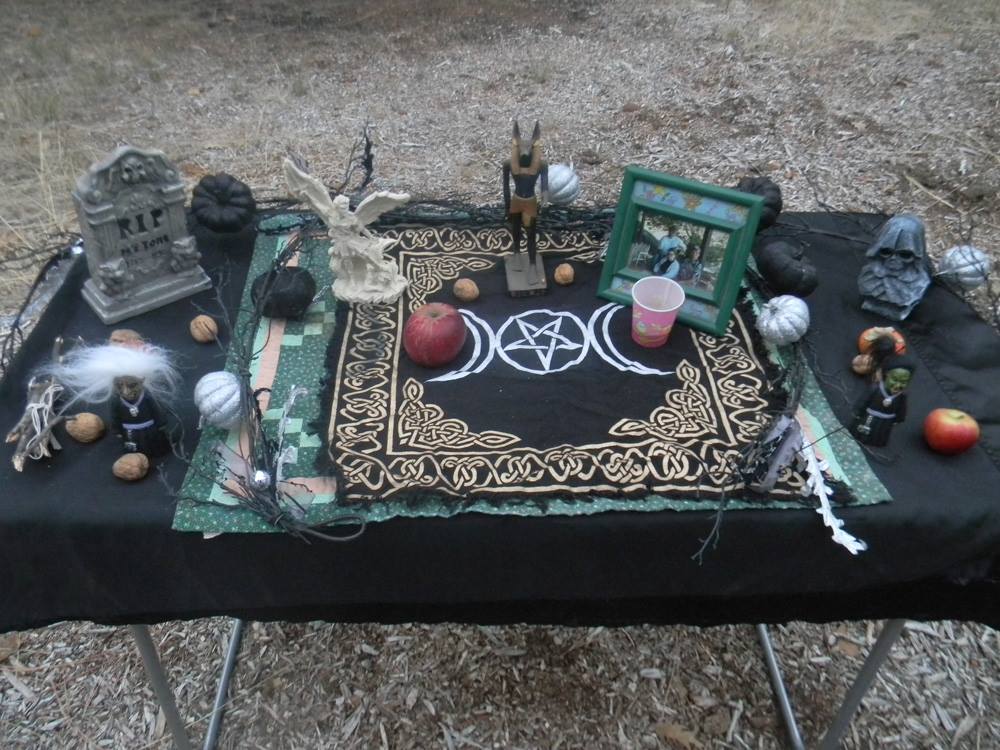
Over the years, we have created many altars honoring the beloved dead. Some were elaborate arrangements with photographs, flowers, candles, symbolic objects, and offerings. Others were simpler, assembled according to the needs of the occasion and the people we wished to remember.
I love this part of Samhain. There is something satisfying about bringing together objects that represent individual lives and arranging them in a place of honor. A photograph, a favorite food, a personal possession, or an object associated with a particular memory can become a point of connection.
But I also think we sometimes become so concerned with doing these things correctly that we lose sight of whom we’re doing them for.
An ancestor altar does not need to look like an illustration from a book about Pagan ritual. The dead are not going to reject your remembrance because your candles don’t match or your flowers came from the grocery store.
And if someone you loved had a wicked sense of humor, I suspect a solemn ceremony filled with hushed voices and elaborate invocations might not be nearly as meaningful as remembering the ridiculous things they did.
I have known people who couldn’t get through a family dinner without making an inappropriate joke. I see no reason to assume that death has transformed them into dignified spiritual beings who expect reverent silence and perfectly arranged chrysanthemums.
We tend to become terribly serious when discussing death, perhaps because we associate solemnity with respect. But laughter is not disrespectful when it comes from love. Remembering someone’s absurd habits, peculiar expressions, terrible jokes, and spectacularly questionable decisions is part of remembering the person they actually were.
The dead don’t have to become perfect for us to love them.
In fact, I think we lose something important when we polish away every rough edge of someone’s personality after they’re gone. We replace a complicated, interesting human being with a sentimental version who never said anything unkind, made a foolish decision, or embarrassed the family.
That person never existed.
The real one did.
Visiting the Neighbors
Another practice my group and I enjoyed over the years is what we call a graveyard crawl. We visit cemeteries, wander among the graves, sit quietly, and spend time with the dead.
I have always found cemeteries fascinating. Every marker represents a life, and every life contains a story. Some graves are lovingly maintained, decorated with flowers and personal objects. Others have stood for generations, their inscriptions worn by weather and time. Some belong to people whose names are still spoken regularly, while others may have gone many decades without anyone visiting.
There’s something deeply human about taking time to notice them.
Sometimes we visit graves connected to our own family histories. Sometimes we encounter people whose stories are entirely unknown to us. I appreciate the opportunity to sit in those places, listen, and acknowledge lives that unfolded long before I arrived.
I don’t assume that every spirit I encounter has an important message for me. Sometimes there is a sense of connection. Sometimes there is curiosity. Sometimes a cemetery is simply a peaceful place to contemplate how many people have lived, loved, struggled, celebrated, and eventually passed from the world.
And sometimes, of course, there are personalities.
Which brings me to another point worth mentioning.
If you engage in spirit communication during cemetery visits, I recommend appropriate spiritual shielding and discernment. I don’t believe that every spirit is dangerous, any more than I believe every living person is dangerous. But I also don’t assume that every spirit is benevolent, helpful, or particularly interested in my well-being.
Remember, some of those graves belong to somebody else’s asshole ancestors.
The Wisdom of Remembering Honestly
I think one of the greatest gifts Samhain offers us is the opportunity to remember honestly.
Our ancestors lived in different times, faced different challenges, and made decisions according to circumstances we may never fully understand. Some did remarkable things. Others caused tremendous harm. Most were probably complicated mixtures of admirable qualities, ordinary weaknesses, questionable judgments, and the occasional spectacular mistake.
In other words, they were human.
We don’t honor them more deeply by pretending otherwise.
We can recognize their contributions without excusing their failures. We can appreciate the strength that helped them survive while rejecting beliefs or behaviors that caused suffering. We can remember those we loved with affection and those who harmed us with whatever degree of distance feels appropriate.
And we can decide whose guidance we want.
That last part matters to me. Spiritual discernment doesn’t end when we cross the boundary between the living and the dead. If anything, it becomes more important, because we can be tempted to grant extraordinary authority to a voice simply because we believe it comes from the other side.
I have encountered spirits whose perspectives I value. I have also encountered those whose opinions I would receive with approximately the same enthusiasm I would have had for their opinions when they were alive.
The fact that someone is dead does not mean they are right.
It doesn’t mean they are wrong, either.
It means we still have to use our judgment.
As Samhain approaches, I look forward to honoring the beloved dead, remembering the people who shaped my life, and acknowledging those who came before me. I’ll appreciate the wisdom where I find it, remember the love where it existed, and leave room for the laughter that makes our memories feel alive.
I won’t pretend everyone was wonderful. I won’t assume everyone became wonderful afterward. And I certainly won’t invite someone into my spiritual life simply because we happen to share an ancestor somewhere along the family tree.
The veil may be thin, but my standards haven’t changed.
Blessed Samhain, everyone.
And if Uncle Harold shows up with unsolicited advice, remember that you’re still allowed to tell him no.
Want to join the conversation about this blog post? Go to the Green Egg Forum and scroll for the forum post that relates to this article
 As Editor of the Green Egg Blog, Katrina Rasbold weaves ancient wisdom into the complexities of modern life, fostering a space for deep inquiry and magical growth. Katrina is the editor of Green Egg Magazine, a priestess, author, and co-creator of the CUSP path, working from the crossroads of tradition and transformation. She owns and operates Crossroads Occult with her husband, Eric, offering a sanctuary for those seeking mentorship, quality handmade magical items, and authentic craft. Discover her full body of work at www.katrinarasbold.com.