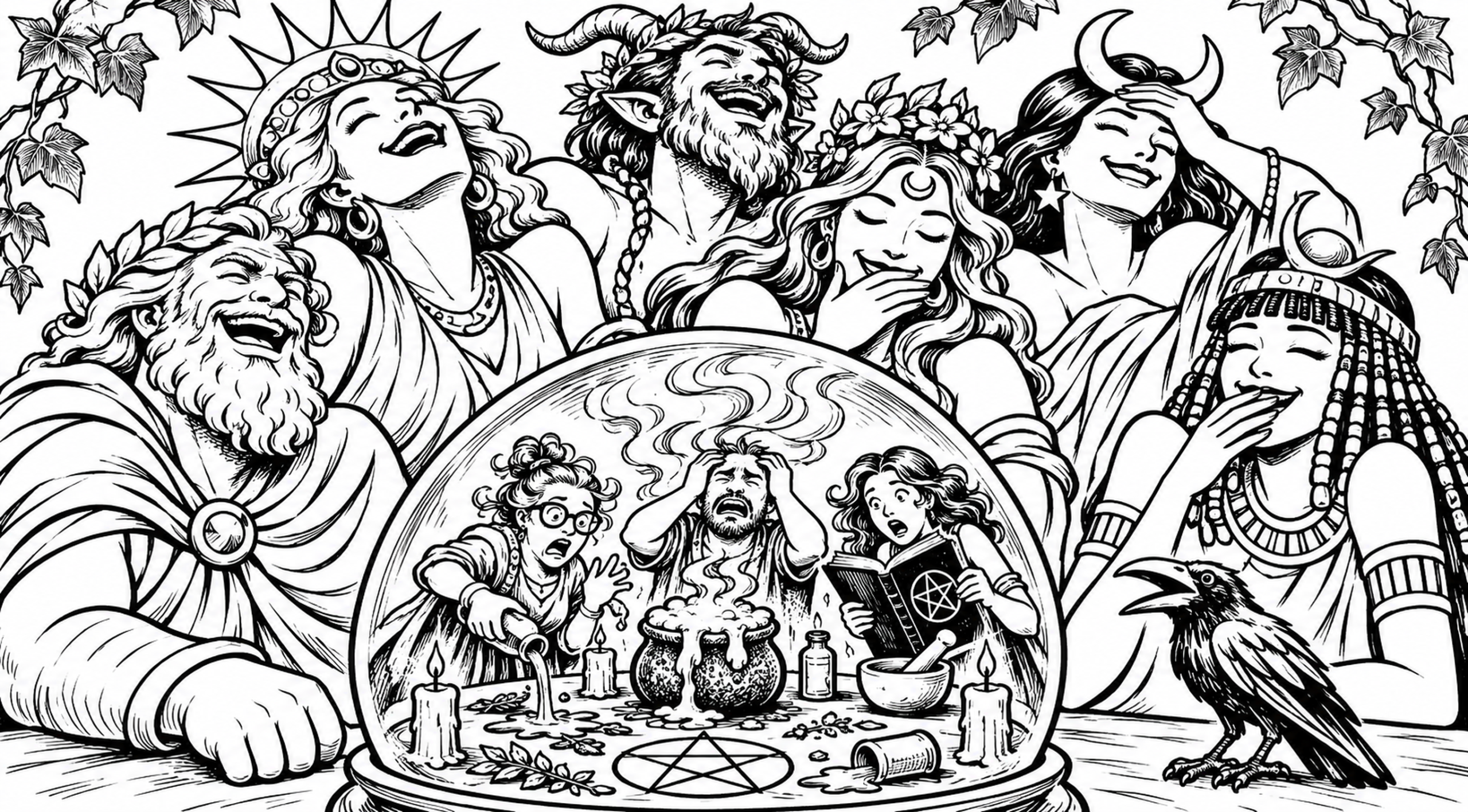
There is a certain image of Pagan ritual that persists in books, films, and the collective imagination. Everyone stands solemnly in a perfectly arranged circle. Candles burn steadily. Incense rises in graceful spirals. The priestess speaks with authority, the participants respond in unison, and the Gods presumably look on with approval.
In actual practice, someone has forgotten the matches, the incense has set off the smoke alarm, and the priestess is trying to remember whether she put the ritual script under the altar cloth or left it in the bathroom.
The Gods, I suspect, have seen worse.
One of the more entertaining aspects of spending over forty years involved in Witchcraft and Pagan spirituality is discovering just how frequently the sacred and the ridiculous occupy the same space. We can prepare a beautiful ritual, carefully select every item, rehearse every word, and establish precisely the atmosphere we hope to create. Then something entirely unexpected happens, and suddenly we’re reminded that we are human beings attempting to conduct sacred ceremonies in a world that has never shown much interest in cooperating with our plans.
Candles refuse to light. Candles refuse to stay lit. Candles that have behaved perfectly well for years suddenly develop an alarming enthusiasm for dripping wax onto something expensive. Incense falls out of its holder. The carefully arranged altar cloth catches on somebody’s bracelet. A ceremonial bell produces a sound more appropriate to a bicycle with a mechanical problem.
I have, hand-to-heart swear, set myself on fire in ritual and not realized it.
And somewhere in the middle of all this, someone is trying very hard not to laugh. It’s not me. I don’t even try to fight back the laugh.
I have always thought that the effort required to suppress laughter during a solemn occasion is one of humanity’s crueler design flaws. A perfectly ordinary mishap can become hysterically funny simply because everyone understands that laughing would be inappropriate. One person makes the mistake of looking at another person, a tiny smile appears, and suddenly the entire ritual is hanging by a thread.
That being said, I’ve even laughed at funerals.
Like my mother’s funeral.
And yes, also my Father’s funeral because it’s only fair.
At that point, you might as well surrender. The more determined you are to maintain a dignified expression, the more likely you are to make a noise resembling a malfunctioning teakettle. If the laugh doesn’t come out the top end and you try to hold it in, chances are it will find another exit point that could be more embarrassing than laughing.
Of course, not every Pagan ritual is intended to be solemn. Some traditions incorporate laughter, dancing, celebration, and deliberate silliness as essential parts of the experience. Others place considerable importance on formality, precision, and reverence. Both approaches have their place, and neither is inherently superior. The difficulty arises when we begin to confuse the outward appearance of a ritual with its spiritual substance.
A beautifully executed ceremony can be profoundly meaningful. So can one in which somebody loses their place, the music starts at the wrong moment, and a participant accidentally answers a ceremonial question with, “What?”
I don’t mean that preparation and attention to detail are unimportant. Quite the contrary. When people have taken time to gather for a shared spiritual purpose, they deserve a ceremony that has been thoughtfully prepared. Ritual leaders have a responsibility to understand what they’re doing, particularly when fire, sharp implements, unfamiliar surroundings, or large groups of people are involved. There is a difference between a harmless interruption and a genuine safety problem, and the latter deserves immediate attention rather than a philosophical discussion about divine humor.
But there is also a difference between respecting a ritual and expecting it to unfold like a theatrical production with a professional stage manager.
The natural world, which occupies such an important place in many Pagan traditions, is particularly indifferent to our expectations of ceremonial dignity. Outdoor rituals offer an almost unlimited selection of opportunities for things to go sideways. Wind blows out candles and carries spoken words in directions nobody intended. Rain arrives despite an encouraging forecast. Insects develop an intense interest in the offerings. The ground turns out to be less level than it appeared, and somebody discovers that their lovely flowing ritual robe is exceptionally good at collecting burrs.
Anyone who has attempted to maintain an air of sacred authority while being investigated by a determined mosquito knows that spiritual discipline has its limits.
And then there are animals.
Animals have absolutely no respect for ceremonial timing. A cat may regard an altar as a particularly attractive collection of objects that have been arranged for its personal amusement. A dog may decide that the precise moment of silent meditation is the ideal opportunity to investigate everyone present or loudly let a squirrel know it’s been spotted. Birds may contribute unsolicited commentary. Somewhere, I am certain, a perfectly sincere invocation has been interrupted by a rooster announcing his own importance to the universe.
It’s difficult to remain convinced that every detail of a ritual must unfold exactly as planned when the local wildlife clearly received a different script.
Human beings are even more unpredictable.
We forget words. We mispronounce names. We become so absorbed in remembering the next part of a ceremony that we momentarily forget what we’re supposed to be doing with our hands. We place something in a very sensible location and then spend ten minutes looking for it. We rehearse a beautiful passage until we can recite it flawlessly, only to discover that our brains have apparently gone on vacation the moment everyone turns to look at us.
And occasionally, we say something that is not remotely what we intended.
One year, I fell into the Mayhole during a profoundly moving recitation. (Yes, we have both a “Mayhole” and a “Maypole.” Duality, baby. Duality.)
Those moments can be mortifying, especially for someone who is new to leading ritual. When we’re inexperienced, we may imagine that the people conducting ceremonies with apparent ease possess some special quality that prevents them from making mistakes. We assume that seasoned practitioners glide through sacred work with effortless confidence, never forgetting a word or wondering where they put the matches.
I regret to report that experience does not necessarily produce this condition.
What experience often provides is the ability to recover.
That’s one of the coveted “third level mysteries” that you learn as you advance in degrees. Another one is that there aren’t really any mysteries and that Inner Court meetings mostly involve us sitting around and smoking pot and drinking wine and showing each other the new rocks we just got.
After enough years of practice, we learn that a forgotten line does not require us to abandon an entire ceremony. A candle that goes out can usually be relit. A misplaced object can be found or replaced. A moment of unexpected laughter does not automatically invalidate the spiritual purpose that brought everyone together.
Sometimes the best response is simply to acknowledge what happened, make whatever adjustment is necessary, and continue.
There is a certain freedom in discovering that we do not have to perform perfection in order to approach the sacred sincerely. In fact, an exaggerated, panicked response will disrupt the ritual even more than the instigating screw up did.
I think this matters particularly in communities where people are learning from one another. If newcomers see experienced practitioners responding to every minor mistake with alarm, embarrassment, or disapproval, they may conclude that spiritual practice is a precarious undertaking in which one wrong word can ruin everything. That can make ritual feel intimidating rather than welcoming, and it may discourage people from exploring practices that could otherwise become meaningful parts of their lives.
On the other hand, watching an experienced priestess calmly retrieve a dropped object, laugh at an unexpected interruption, or admit that she has forgotten something can be remarkably reassuring. It demonstrates that competence does not require infallibility.
There are, of course, traditions in which exact wording, sequence, or ritual procedure carries particular religious significance. Those requirements deserve respect, and it would be presumptuous to dismiss them simply because my own approach allows room for improvisation. Paganism encompasses far too many traditions and understandings of the sacred for any one practitioner to declare that mistakes never matter.
But even where precision is important, the people attempting to achieve it remain human. We can take our responsibilities seriously without treating every imperfection as a spiritual catastrophe.
And I sometimes wonder whether our anxiety about getting everything right says more about our expectations of ourselves than it does about our relationships with the Gods.
Those who understand deity as personal and responsive may have their own ideas about how the Gods receive our efforts. I can’t speak for every deity, tradition, or practitioner, and I wouldn’t presume to know exactly what divine beings find amusing. But I have difficulty imagining that the sacred is so fragile that an accidentally overturned chalice or an unfortunate sneeze could bring the entire relationship crashing down.
If a lifetime of sincere devotion can be undone by somebody tripping over a ritual robe, we may need to reconsider what we think devotion actually means.
For those whose Pagan spirituality is centered less on personal deities and more on nature, philosophical principles, or other expressions of the sacred, the question may be somewhat different. Yet the underlying experience remains recognizable. We bring our intentions, our attention, and our imperfect human selves to something we consider meaningful. Sometimes it goes beautifully. Sometimes it goes hilariously wrong. Often, it does a little of both.
I have come to appreciate that combination.
Some of the most memorable spiritual experiences are not the ones in which every detail proceeded flawlessly. They are the ones in which something unexpected reminded us that we were sharing a genuine moment with genuine people. The laughter that followed an awkward interruption, the kindness someone showed a nervous participant, or the collective determination to carry on after the weather thoroughly demolished our plans can become as memorable as the ceremony itself.
That doesn’t make the sacred less sacred. It makes the experience human.
And perhaps that’s worth remembering in an era when we see so many carefully photographed altars, beautifully edited ritual videos, and polished presentations of spiritual life. There’s nothing wrong with creating something lovely or sharing it with others. But the finished image rarely includes the twenty minutes spent untangling the decorations, the candle that wouldn’t stand upright, or the moment someone realized the ceremonial music was still playing through a speaker in the other room.
We see the result, not necessarily the process.
Real spiritual practice includes both.
It includes the carefully considered words and the ones we accidentally mangle. It includes the beautiful altar and the spilled offering. It includes moments of profound stillness and moments when somebody’s stomach growls loudly enough to interrupt the meditation.
It includes laughter, frustration, tenderness, reverence, and occasionally a few words that are probably not suitable for inclusion in the official ritual script.
After more than forty years, I still believe that what we bring to our spiritual practices matters. Our sincerity matters. Our preparation matters. Our willingness to learn, to show respect, and to remain present matters. We are spiritual beings leading a mundane life; not mundane beings leading a spiritual life.
I no longer see any reason to confuse dignity with perfection, or reverence with the complete absence of humor.
The next time something harmless goes wrong during a ritual, take care of whatever needs attention, allow yourself a smile, and remember why you gathered in the first place. You may discover that the moment has lost none of its meaning.
And if you happen to forget the words, drop the bell, fall in the Mayhole, or find yourself trying to conduct a solemn invocation while a cat methodically pushes objects off the altar, remember that generations of practitioners have undoubtedly experienced their own versions of the same indignity.
The Gods have seen worse.
And if they haven’t, well, somebody was bound to give them a good story eventually.
Want to join the conversation about this blog post? Go to the Green Egg Forum and scroll for the forum post that relates to this article
 As Editor of the Green Egg Blog, Katrina Rasbold weaves ancient wisdom into the complexities of modern life, fostering a space for deep inquiry and magical growth. Katrina is the editor of Green Egg Magazine, a priestess, author, and co-creator of the CUSP path, working from the crossroads of tradition and transformation. She owns and operates Crossroads Occult with her husband, Eric, offering a sanctuary for those seeking mentorship, quality handmade magical items, and authentic craft. Discover her full body of work at www.katrinarasbold.com.