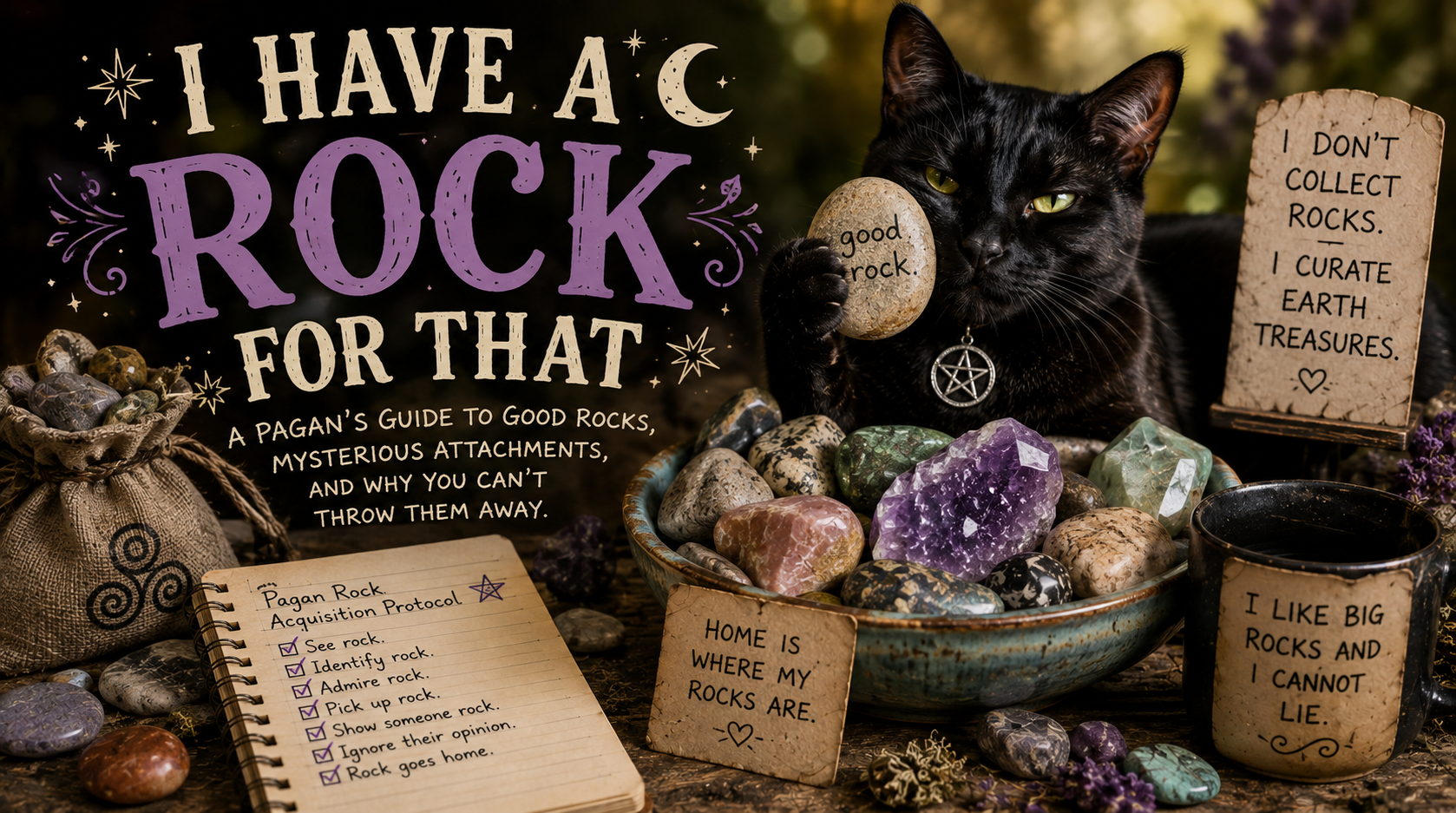
There is a particular sound a Pagan makes when encountering a good rock. It isn’t quite a word. It’s more of an oooh. The rock may be lying beside a creek, embedded in the dirt along a trail, sitting at the edge of a parking lot, or minding its own business somewhere completely unremarkable. This does not matter. Something about it has caught our attention, and now we must pick it up.
I have a strong working knowledge of stones. I can usually identify what I’m looking at, and I’m familiar with the magical and metaphysical properties traditionally associated with many of them. This does absolutely nothing to prevent the ancient instinct known as Good rock. Must have.
In fact, knowledge may make the situation worse. The process is fairly straightforward: see rock, identify rock, admire rock, pick up rock, turn rock over, examine other side of rock, and show rock to Eric. Eric acknowledges that yes, it is indeed a rock. His assessment is technically correct but fails to appreciate the significance of this particular rock, so we ignore his opinion.
Rock goes into pocket. Rock comes home. At no point during this process is it necessary to determine what we’re going to do with the rock. That’s a problem for Future Us. Present Us has found a good rock.This is an inadequate response, but we move on. Rock goes into pocket. Rock comes home. At no point during this process is it necessary to determine what we’re going to do with the rock. That’s a problem for Future Us. Present Us has found a good rock.
Crystals Have Résumés
Things are different when we deliberately shop for stones. Walk into any metaphysical store and the crystals are practically standing there holding little résumés. Amethyst: spiritual awareness, tranquility, intuition, psychic development. Rose quartz: love, compassion, emotional healing. Citrine: prosperity, confidence, abundance. Black tourmaline: protection, grounding, energetic boundaries. Excellent qualifications. We’ll keep your application on file.
Sometimes that’s exactly how we choose a stone. We have a purpose in mind, know what qualities we’re looking for, and select accordingly. There’s nothing wrong with that. I’ve done it countless times. But then there’s the rock beside the creek. It has no little identification card. Nobody has polished it into a tower. It isn’t nestled dramatically on black velvet beneath flattering track lighting. It’s wet, dirty, and possibly has a bug underneath it. And yet…oooh.
That’s the part I find interesting. You can know exactly what kind of stone you’re holding. You can know its geological characteristics and its magical associations. You may already own several beautiful specimens of exactly the same material. Doesn’t matter. This one is different. Maybe the color is unusual. Maybe there’s an interesting inclusion or band running through it. Maybe water has worn it into a particularly satisfying shape. Maybe it fits perfectly into your palm. Or maybe you simply noticed it. Among hundreds or thousands of stones, your attention landed on that one. I don’t think everything needs a mystical explanation. Sometimes a rock catches our attention because it’s a really cool rock. That’s enough.
The Rocks From Places
Then there are the dangerous ones: the rocks from places. These acquire an entirely different status. This is the stone from that beach. This one came from the river. This one was from the trip where it rained the entire time. This one came from the property where we used to live. This one was in my pocket when something important happened. At that point, geological identification becomes almost secondary. The stone has become a physical bookmark.
Years later, you can pick it up and remember. Maybe not everything. Memory is peculiar that way. You might forget the date, what you were wearing, or exactly who was there, but you remember the cold water around your ankles, the smell of the forest, the afternoon light, the way the air felt. The rock remembers the place for you. Not literally, perhaps. Although this is Green Egg, so I’m certainly not going to tell you what your rock does or doesn’t remember.
The difficulty comes later when another member of the household encounters the collection and asks, “Do you need all these rocks?” I’m sorry. I don’t understand the question. Need? Do I need the framed photographs on the wall? Do I need the little object someone gave me twenty years ago? Do I need the ticket stub tucked into an old book? That’s not how sentimental objects work. And yet rocks are particularly vulnerable because, to the uninitiated, they look suspiciously like something available outside for free. This is technically true. It is also completely irrelevant. You cannot replace Rock From That Place with another rock from the yard. That’s not how rocks work. I don’t make the rules.
A Respectable Career for a Rock
Of course, eventually some of our acquisitions do find employment. A stone ends up on an altar. Another gets tucked into a plant pot. One becomes part of a spell or ritual. A particularly satisfying specimen lives on the desk where we can pick it up while thinking. Others migrate into bowls, baskets, windowsills, pockets, gardens, medicine bags, or the mysterious household ecosystem where small Pagan objects naturally congregate. Some become magical tools, some become decorations, some become memories, and some remain on a shelf for fifteen years waiting patiently for us to remember why we brought them home. I maintain that all of these are legitimate careers for a rock.
Humans have been picking up interesting stones for an extraordinarily long time. Long before metaphysical shops and crystal guidebooks, people carried stones, traded them, carved them, wore them, buried them with their dead, built sacred places from them, and assigned meaning to them. Some were precious because they were rare, some because they were beautiful, some because they came from somewhere important, and some because somebody decided this one matters. That last part feels particularly familiar.
Pagans talk frequently about our relationship with the natural world, usually in considerably more dignified language than oooh, good rock. But perhaps this counts, too. There is something wonderfully direct about seeing a piece of the earth and feeling affection for it. No elaborate theology required.
Over the years, I’ve accumulated stones for protection, prosperity, healing, divination, grounding, love, communication, spiritual work, and purposes so specific that I’m fairly certain I could produce a mineral response team for most situations. But some of the stones I value aren’t particularly impressive specimens. They wouldn’t cost much. They aren’t rare. Nobody looking at them would immediately understand why I kept them. I do. That’s enough.
Maybe that’s why Pagans have such a difficult time walking past a good rock. We know stones can have properties, correspondences, histories, and uses, but we also understand something much simpler: not everything we value needs to earn its place by being useful. Sometimes you choose a rock because you need something for protection. Sometimes you choose one because it carries the memory of a place you loved. And sometimes you’re walking along, minding your own business, when something catches your eye. You stop. You pick it up.
Oooh.
Good rock.
That one’s coming home with me.
Want to join the conversation about this blog post? Go to the Green Egg Forum and scroll for the forum post that relates to this article
 As Editor of the Green Egg Blog, Katrina Rasbold weaves ancient wisdom into the complexities of modern life, fostering a space for deep inquiry and magical growth. Katrina is the editor of Green Egg Magazine, a priestess, author, and co-creator of the CUSP path, working from the crossroads of tradition and transformation. She owns and operates Crossroads Occult with her husband, Eric, offering a sanctuary for those seeking mentorship, quality handmade magical items, and authentic craft. Discover her full body of work at www.katrinarasbold.com.