By Katrina Rasbold
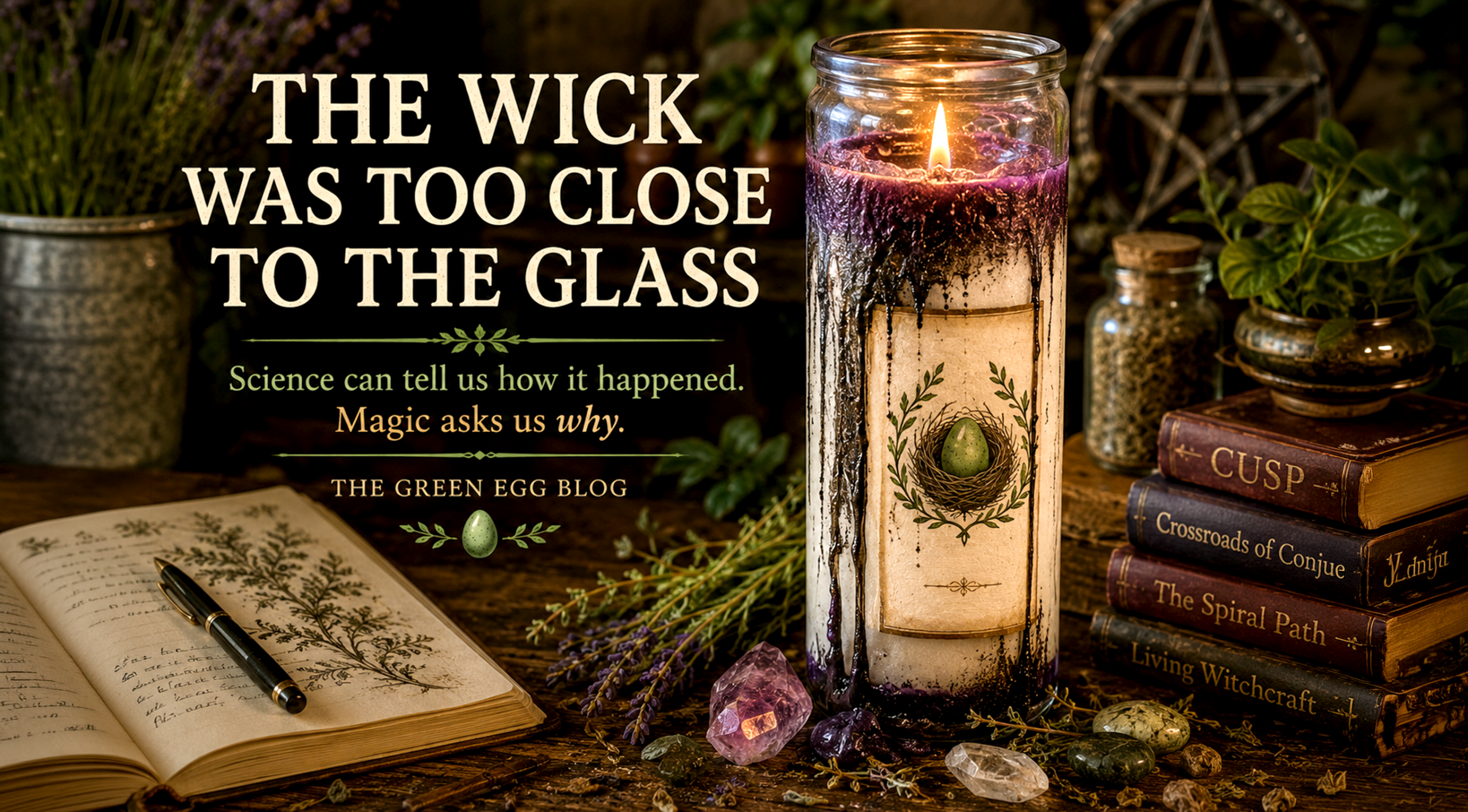
I read candles for a living, among other things. When I finish spellwork for a client, the prayer candle itself is part of the reading, and I pay close attention to what happened while it burned. Black soot on the glass traditionally indicates resistance or obstacles. White soot can indicate divine or spiritual assistance. Wax that manages to break through the glass and bleed down across the label is a breakthrough, although often not a particularly gentle one. The way the wax pools, the direction it moves, the condition of the wick, the residue on the glass, and the behavior of the flame can all contribute information about how the working progressed.
I also know perfectly well that candles are physical objects and, I can embrace those magical words, “Science is a thing.”
A long streak of black soot running down one side of a glass candle may have a perfectly ordinary explanation: the wick was positioned too close to the glass. The flame burned against that surface and deposited carbon as it went. There is nothing particularly mysterious about the mechanics of it, and understanding those mechanics does not bother me in the slightest.
And that sometimes becomes an issue. “Your candle is mostly clear, but we have this long, heavy streak of black soot running up the side, showing that the energy of the spell encountered resistance it had to power through,” is what I might say. The client scoffs and says, “The wick was just too close to the side of the glass.”
Well, sure it was, but what interests me as a magical practitioner is the next question.
Why did I choose that specific candle for that specific spellwork for that specific person at that specific time so I could give them that specific message?
Science can tell me how the soot got there. Magic asks me whether it means anything that this was the candle that produced it.
Those are not the same question and the two concepts are not in conflict.
Magic Does Not Have to Stop Being Physics
I have never required magic to stop obeying the laws of physics in order to believe that magic is happening. In fact, most of the magical practices humans developed over thousands of years work through completely ordinary physical things. We burn plants and resins. We light candles. We immerse ourselves in water. We arrange stones. We shuffle cards. We plant things in the earth. We listen to birds, watch clouds, observe the moon, pay attention to dreams, and notice what happens around us.
All of those things have physical explanations.
Tarot cards appear in a particular order because someone shuffled a deck of printed cardboard and then drew cards from it. A candle flame moves because of combustion, convection, airflow, and the condition of the wick. Herbs contain actual chemical compounds. The moon exerts gravitational force. Birds have reasons of their own for doing whatever birds are doing, most of which probably have nothing whatsoever to do with us.
None of that makes these things magically useless.
If Eric makes a hundred candles and one of them has a wick slightly off-center, there is a manufacturing explanation for that. If I unknowingly select that candle for a working involving a situation already fraught with resistance, and it produces a dramatic black streak precisely where that resistance would traditionally be indicated, I don’t need to deny the manufacturing explanation.
The wick was too close to the glass.
I agree.
But why did I pick that one?
That is where magic lives for me—not necessarily in the absence of cause, but in the intersection of cause, circumstance, timing, intention, and meaning.
Sometimes a Crow Is Eating a French Fry
Of course, there is a danger in the other direction, and Pagans can be spectacularly good at it.
Not everything is a sign.
Sometimes a candle flickers because the central air kicked on. Sometimes a Tarot card jumps out of the deck because you’re a terrible shuffler. Sometimes you wake up at 3:17 every morning because your bladder has developed an extremely reliable internal clock. Sometimes the crow who has been staring meaningfully into your soul for the past ten minutes is actually staring meaningfully at the French fry in your hand.
And sometimes the fairies did not take your keys.
You laid them down in the freezer when you moved aside the fourteen packages of frozen stir-fry vegetables–the ones you inexplicably bought because you keep thinking you are out of frozen stir-fry vegetables–to put another freezer spell behind them on your way out the door for a dental appointment. Don’t worry! You will find them in seven years when you use that last bag of frozen stir-fry vegetables.
There is a wonderfully fuzzy territory between paying attention to the world and assigning cosmic significance to every mildly unusual thing that happens in it. I don’t know exactly where that line is. After all these years, I’m not particularly convinced that anybody else knows either.
Discernment matters. Experience matters. Knowing the ordinary behavior of the thing you’re observing matters enormously. If you don’t know what candles normally do, everything a candle does can look supernatural. If you’ve watched thousands of them burn, you develop a considerably better sense of what falls within the ordinary range.
Which brings us to my favorite category.
And Then the Candle Does Something Really Weird
Every now and then, something happens that makes me stop what I’m doing and stare.
I have worked with candles long enough to know how wax and heat and oil and herbs behave in almost any set of circumstances. I know that heat melts it, gravity moves it, drafts affect flame, wicks wander, glass has flaws, dyes and fragrances affect burns, and mass-produced candles occasionally come out of the factory with peculiarities. I am not watching every drip of wax thinking the spirit world just sent me a telegram.
That experience is also precisely why I recognize when something is genuinely weird.
Sometimes a burn behaves in a way I did not anticipate. Sometimes the resulting wax forms something astonishingly recognizable. Sometimes candles in a ritual interact in ways that mirror the people or circumstances they represent with an accuracy that is downright eerie. Sometimes something happens for which I can imagine a physical explanation, but the timing and context are so remarkable that the explanation feels incomplete.
And occasionally, after decades of doing this work, a candle does something that leaves me with no immediately satisfactory explanation at all.
And that’s really cool.
I don’t have to leap from I don’t know why that happened to I have personally witnessed the suspension of the laws of physics but let me tell you, I don’t rule it out. There is a vast universe of things I don’t know, including plenty of perfectly ordinary ones and some truly extraordinary ones. Maybe there is a physical explanation I haven’t considered. Maybe I missed something. Maybe the candle did something candles occasionally do and I’ve simply never seen one do it before.
Or maybe something magical happened.
I’m comfortable leaving that door cracked open.
“[Chaos] deals with predictability in complex systems.” Ian Malcolm, 1993
“Magic sometimes does weird shit we don’t understand and can’t reasonably explain and that’s unbelievably cool.” Katrina Rasbold, All The Damned Time
I Don’t Need to Choose
I think this is one of the things I value most about living a magical life. I don’t have to choose between understanding the world and experiencing it as enchanted.
Knowing what causes a rainbow does not make a rainbow less magnificent. Understanding how a seed germinates doesn’t make planting one less sacred. Knowing the chemical constituents of an herb doesn’t prevent me from working with its magical correspondences. Knowing that my Tarot deck consists of seventy-eight pieces of cardstock does not make the cards less capable of saying something that occasionally causes me to stare at them and mutter, “Well, shit. I just got called out.”
For me, magic has never depended upon ignorance.
Quite the opposite. The more I understand about the materials I use and the way they ordinarily behave, the more interesting it becomes when the ordinary and the meaningful intersect—and the more impressive it is when something happens that I genuinely cannot explain.
So yes, science may look at the long streak of black soot slicing down a candle glass and tell me that the wick was too close to the side.
I may look at the same candle and say that the working encountered resistance.
Neither explanation particularly threatens the other. One tells me something about combustion and wick placement. The other comes from the symbolic language and accumulated experience of the magical practice in which I am using that candle.
And every once in a while, the candle does something that leaves both explanations feeling a little inadequate.
Those are the days when I get to lean closer, look at what just happened, and say:
“Okay. That was really cool.”
Want to join the conversation about this blog post? Go to the Green Egg Forum and scroll for the forum post that relates to this article
 As Editor of the Green Egg Blog, Katrina Rasbold weaves ancient wisdom into the complexities of modern life, fostering a space for deep inquiry and magical growth. Katrina is the editor of Green Egg Magazine, a priestess, author, and co-creator of the CUSP path, working from the crossroads of tradition and transformation. She owns and operates Crossroads Occult with her husband, Eric, offering a sanctuary for those seeking mentorship, quality handmade magical items, and authentic craft. Discover her full body of work at www.katrinarasbold.com.