By Katrina Rasbold
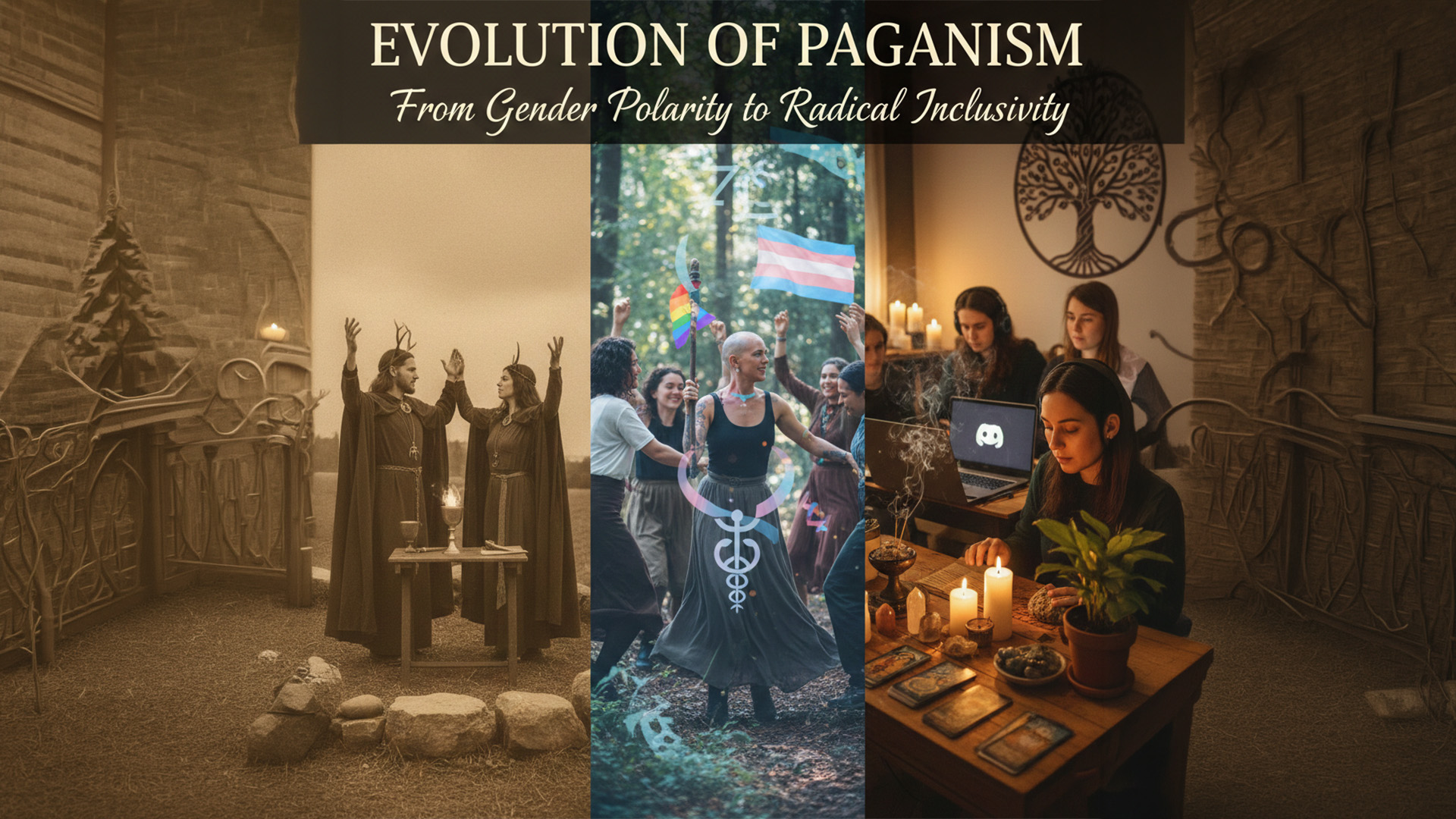
The landscape of modern Paganism has shifted dramatically over the last fifty years. What began in the mid-20th century as a movement deeply rooted in the divine gender binary has blossomed into a diverse, decentralized spiritual umbrella that increasingly prioritizes radical inclusivity.
The 1970s: The Era of the Great Mother and the Horned God
In the 1970s, the Pagan Renaissance was heavily dominated by Traditional Wicca. At the time, this was revolutionary—it moved away from patriarchal monotheism to a return of the veneration of the Great Mother Goddess. However, this empowerment was built on a foundation of Gender Polarity.
-
The Fertility Focus: Rituals often centered on the Great Rite, a symbolic or literal union between male and female energies.
-
Biological Essentialism: Magic was frequently explained through the lens of biological reproduction. To make magic, one supposedly needed a balance of masculine and feminine forces, often mapped strictly onto cisgender men and women.
-
Rigid Roles: High Priests and High Priestesses held distinct, complementary roles. While this elevated women to positions of power, it left little room for those who didn’t fit the binary.
The Queer Shift: Breaking the Binary
As the decades progressed, LGBTQ+ practitioners—who had always been a quiet backbone of the movement—began to challenge the polarity requirement. The 1980s and 90s saw the rise of traditions like Radical Faeries and Dianic Witchcraft (though the latter famously struggled with its own internal debates regarding trans-inclusivity).
Modern Paganism has largely moved toward a spectrum model of divinity:
-
De-linking Gender from Sex: Contemporary Pagans often view “Masculine” and “Feminine” as internal archetypes available to everyone, regardless of anatomy.
-
Queer Deities: Increased research into historical polytheism has brought gender-bending deities to the forefront, such as the Norse god Loki, the Greek Hermaphroditus, or the Phrygian Cybele.
-
Gender-Neutral Ritual: Many modern covens have swapped “Priest/Priestess” for “Officiant” or “Priestex,” and rites now focus on the union of elements (Earth, Air, Fire, Water, & Spirit) rather than gendered bodies.
Neurodiversity and the Unseen Realm
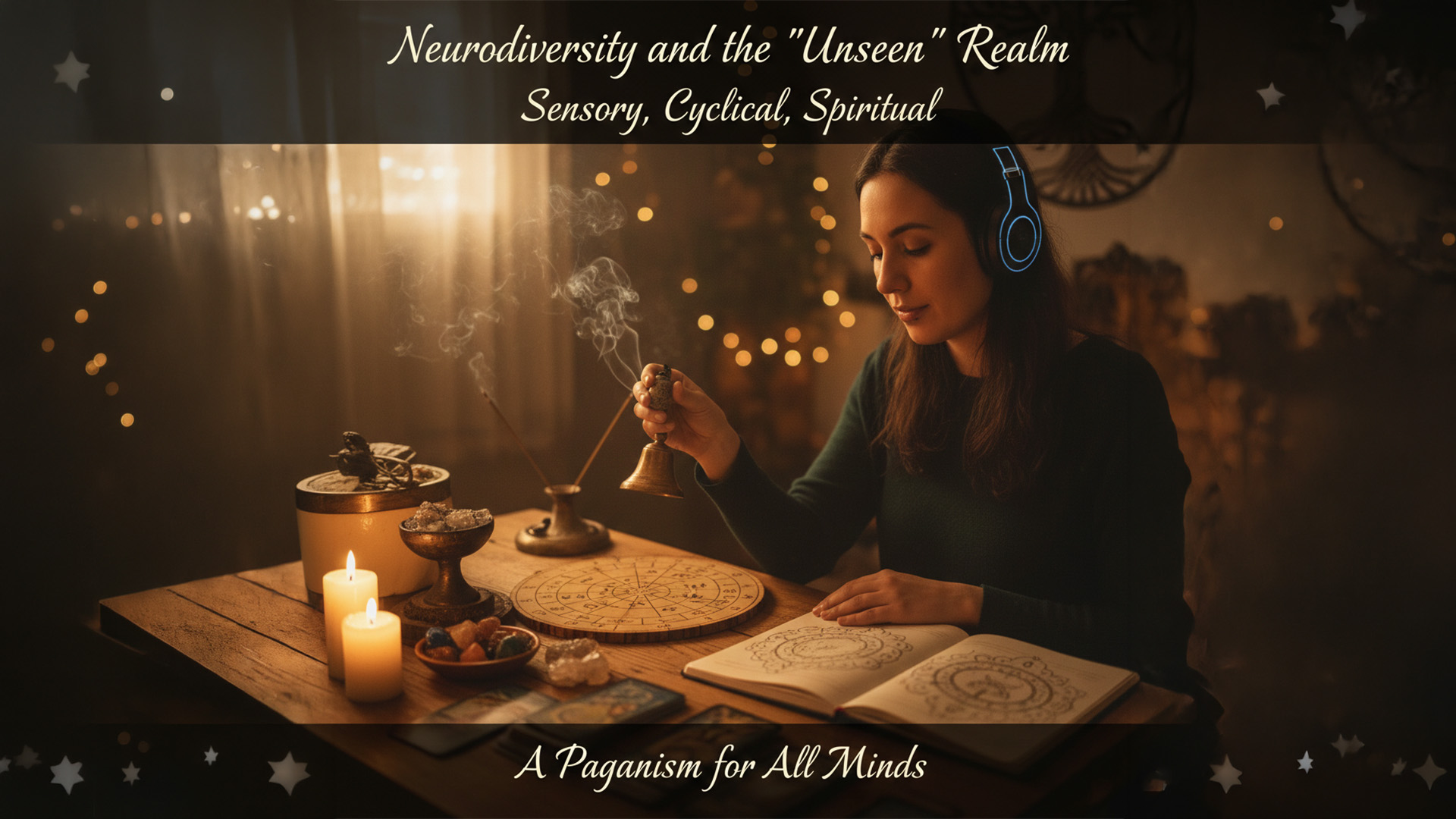
Perhaps the most recent evolution in the Pagan community is the explicit embrace of neurodiversity. Paganism’s inherent flexibility makes it uniquely suited for autistic, ADHD, and otherwise neurodivergent practitioners.
-
Sensory Magic: Unlike traditional church settings, Paganism encourages “stimming” through the use of incense, bells, textured stones, and chanting.
-
Non-Linear Time: The Wheel of the Year honors cyclical time rather than corporate, linear productivity, which often resonates with those who struggle with executive dysfunction.
-
The Shamanic Perspective: Many in the community are reframing neurodivergent traits not as disorders, but as specific spiritual sensitivities—being “thin-blooded” or more attuned to the spirit world.
The Modern Synthesis: A Big Tent Spirituality
Today, a typical Pagan gathering looks very different than it did in 1975. You are just as likely to see a non-binary person leading a ritual as you are to find an “un-coven” that meets via Discord to accommodate members with social anxiety or physical disabilities.
The focus has shifted from Fertility (the ability to reproduce) to Creativity (the ability to manifest change). This transition allows Paganism to remain a living, breathing tradition that reflects the humans practicing it today.
The Living Tradition
Modern Paganism has proven itself to be remarkably resilient precisely because it prioritizes personal gnosis and lived experience over rigid dogma. By moving away from the restrictive binaries of the 1970s, the movement has not lost its connection to the Earth or the Divine; rather, it has expanded its understanding of what Nature actually looks like.
Nature is not a monolith of heterosexual pairs or neurotypical patterns. It is a riot of diversity, adaptation, and unique expressions of life. As practitioners continue to deconstruct old barriers, they create a spiritual home where the outsiders of society are the architects of the sacred. In this new era, the most potent magic is no longer found in conformity, but in the radical act of being exactly who you are.
Further Reading: Significant Voices of the Inclusive Movement
LGBTQ+ & Gender Inclusivity
-
Yvonne Aburrow – All Acts of Love & Pleasure: Inclusive Wicca: A foundational text for those wanting to practice Wicca without the rigid gender binary. Aburrow explores how to make rituals inclusive of all sexualities and gender identities.
-
Tomás Prower – Queer Magic: LGBT+ Spirituality and Culture from Around the World: Prower provides a global and historical perspective, proving that queer identities have always been intertwined with the sacred and the magical.
-
Cassandra Snow – Queering Your Craft: Witchcraft from the Margins: This book is a practical guide for those who feel the traditional “Mother/Father” archetypes don’t fit, offering ways to adapt spells and rituals for marginalized identities.
-
Misha Magdalene – Outside the Charmed Circle: A deep dive into gender and sexuality within magical practice, perfect for those looking to deconstruct the “biological essentialism” of 1970s-era traditions.
-
Storm Faerywolf – The Satyr’s Kiss: Focusing on queer men and non-binary practitioners, Faerywolf explores sex magic and spirituality through a lens that celebrates queer desire as a holy force.
Neurodiversity & Mental Health
-
Mat Auryn – Psychic Witch: While not exclusively about neurodiversity, Auryn’s approach to meditation and energy work is highly adaptable for ADHD and Autistic minds, focusing on sensory-based visualization and internal tuning.
-
Raven Kaldera – Hermaphrodeities and Dealing with Deities: Kaldera’s work often touches on atypical experiences, providing a space for those who experience the world (and the gods) through a more intense, sensory, or shamanic lens.
-
Sarah Griffith Lund – Blessed Minds: Though writing from a broader spiritual perspective, her advocacy for neuro-inclusive communities is being widely adopted by Pagan circles looking to accommodate different cognitive styles.
Radical & Social Justice Perspectives
-
Lasara Firefox Allen – Jailbreaking the Goddess: A revolutionary look at the Triple Goddess (Maiden, Mother, Crone) archetype, arguing that pinning a woman’s value to her reproductive stage is outdated and exclusionary.
-
Laura Tempest Zakroff – The New Aradia: An anthology focusing on magical resistance, highlighting how modern Pagans use their craft as a tool for social change and protection of the vulnerable.
 Katrina Rasbold is a professional Witch, published author, priestess, and editor of Green Egg Magazine. She and her husband, Eric, are the creators of the CUSP spiritual path and owners of Crossroads Occult. You can reach her and access her Patreon with deeper classes and mentorship through www.katrinarasbold.com.
Want to join the conversation about this blog post? Go to the Green Egg Forum and scroll for the forum post that relates to this article: https://www.facebook.com/groups/1069823176940972