Election Day is Tuesday, and I suspect there are a great many people who would happily fast-forward to Wednesday if they could. Of course, that assumes Wednesday will bring some measure of relief (or election results), and I’m not sure anyone is willing to make that promise. At this point, I think a substantial portion of the population would settle for a good night’s sleep and a week without someone shouting at them about politics.
We are living through an extraordinarily divisive time, but I don’t need to tell you that. People are frightened, angry, exhausted, and deeply concerned about what the future holds. Some are worried about their families, their livelihoods, their safety, or their fundamental rights. Others are concerned about the direction of the country, the stability of its institutions, the future of democracy, or the values they believe are being threatened. The specific concerns may be different, sometimes profoundly so, but the emotional strain is real.
And somewhere in the middle of all this, we are still trying to be spiritual people.
I have been practicing Witchcraft for more than forty years, and I have lived through quite a few elections, political controversies, and periods of social upheaval. I remember when political disagreements could produce a lively argument over Thanksgiving dinner, followed by pie and a collective agreement never to discuss politics at Thanksgiving again. Naturally, everyone would forget that agreement by the following November.
These days, some of those people aren’t coming to Thanksgiving dinner at all.
That is one of the things I find most heartbreaking about our present circumstances. Friendships that survived decades have ended. Family members have stopped speaking. People who once loved and trusted one another have discovered differences they cannot reconcile. In some cases, those differences have revealed things about the other person that fundamentally change the relationship.
I don’t believe every fractured relationship represents a failure of compassion or communication. Sometimes a disagreement reveals a genuine conflict in deeply held values. Sometimes maintaining a relationship would require someone to overlook behavior or beliefs they find morally unacceptable. And sometimes walking away is the most honest choice available, even when it hurts terribly.
We see someone we love in a new light and think, “I didn’t know that about you and that’s a deal-breaker for me.”
We are often encouraged, particularly in spiritual communities, to respond to conflict with love, understanding, and forgiveness. Those are worthwhile qualities, but they are not universal solutions. Compassion does not require complicity. Forgiveness does not necessarily require reconciliation. And being spiritually grounded does not mean becoming so agreeable that we no longer stand for anything.
I have never believed that spiritual maturity requires us to abandon our conscience. Quite the opposite.
At the same time, I don’t particularly want to spend the rest of my life furious.
There is a difference between having convictions and allowing conflict to occupy every available corner of our minds. There is a difference between recognizing something we believe is wrong and spending every waking hour feeding our outrage about it. Anger can be useful. It can alert us to injustice, motivate us to protect others, and give us the courage to act when remaining silent would be easier. But anger is a demanding houseguest. If we let it move in permanently, it will eventually start rearranging the furniture and helping itself to the refrigerator contents.
And that brings me to the spiritual question I’ve been considering as this election approaches: How do we remain connected to our spiritual center when the world around us seems determined to pull us away from it?
I don’t think the answer is to pretend everything is fine. I certainly don’t think it is to declare that everyone is equally right, everyone is equally wrong, and we should all just hold hands and sing something uplifting. There are legitimate moral disagreements in the world, and some of them have consequences that extend far beyond hurt feelings. People can be harmed by the choices others make. Recognizing that is not a failure of spiritual perspective.
Nor do I believe that maintaining our spiritual center means withdrawing from the world. Paganism encompasses an extraordinary range of religious and philosophical traditions, and we don’t all approach civic responsibility in the same way. Some Pagans are politically active, some prefer quieter forms of community involvement, and others maintain a separation between their religious and political lives. There is no single Pagan political position, just as there is no single Pagan theology.
But whatever our individual approach, we still have to live in the world that emerges from the decisions being made around us.
For me, spirituality is not something I put away when circumstances become uncomfortable. It is the foundation from which I approach those circumstances. My values don’t disappear when someone challenges them, and I don’t suddenly become a different person because an election produces an outcome I didn’t want. If anything, difficult times provide an opportunity to examine how faithfully I am living according to the principles I claim to hold.
That examination isn’t always pleasant. I can be impatient. I can be judgmental. I can become so frustrated with something that I stop listening long enough to understand what is actually being said. After more than four decades of spiritual practice, I would love to report that I have achieved perfect serenity in the face of provocation, but that would be a spectacular lie. Some days, the most spiritually enlightened thing I manage is closing my mouth before the words escape.
I count those days as partial victories.
One of the benefits of a sustained spiritual practice is that it gives us somewhere to return when we lose our balance. For some Pagans, that may be prayer or communion with deity. For others, it may be meditation, time spent in nature, devotional work, or simply sitting quietly in a sacred space. Those of us who practice magic may find comfort and purpose in ritual, candle work, or other familiar methods of focusing our intentions.
None of these practices guarantees that the world will behave as we wish. I have yet to discover a ritual that persuades several million people to behave sensibly at the same time, although I imagine the demand for one would be considerable.
What our practices can offer is something less spectacular and, in many ways, more useful. They can remind us who we are when circumstances threaten to overwhelm us. They can help us distinguish between what we can influence and what we cannot. They can give us a place to acknowledge our fear, grief, and anger without allowing those emotions to make every decision for us.
I think that distinction matters enormously.
We cannot always choose what happens around us, and we cannot control what other people believe. We can, however, decide how we will respond. We can examine information carefully rather than accepting everything that confirms our existing opinions. We can recognize when our anger is prompting meaningful action and when it is merely exhausting us. We can protect our peace without becoming indifferent to the suffering of others.
We can also acknowledge grief.
There is real grief in discovering that someone you love sees the world in a way you cannot understand or reconcile. There is grief in recognizing that a friendship is unlikely to survive a difference in values. There is grief in watching communities fracture, especially when those communities once provided comfort, belonging, and a sense of shared purpose.
We don’t always talk about those losses as grief because the people involved are often still very much alive. They may still live down the street, attend the same gatherings, or appear in family photographs. Yet the relationship we once knew may no longer exist, and there is no funeral or established ritual to mark its passing.
Sometimes we need to allow ourselves to mourn what has changed without immediately trying to repair it. Not every loss is reversible, and not every boundary is an invitation to negotiate. Once we have seen, we can’t unsee.
I also think we need to be careful about confusing compassion with agreement. It is possible to recognize another person’s humanity while firmly rejecting something they believe or do. It is possible to understand that someone is afraid without accepting the conclusions they have drawn from that fear. We can remain open to learning and reconsidering our own assumptions without treating every moral question as a matter of personal preference.
Our spiritual principles should help us navigate those distinctions, not erase them.
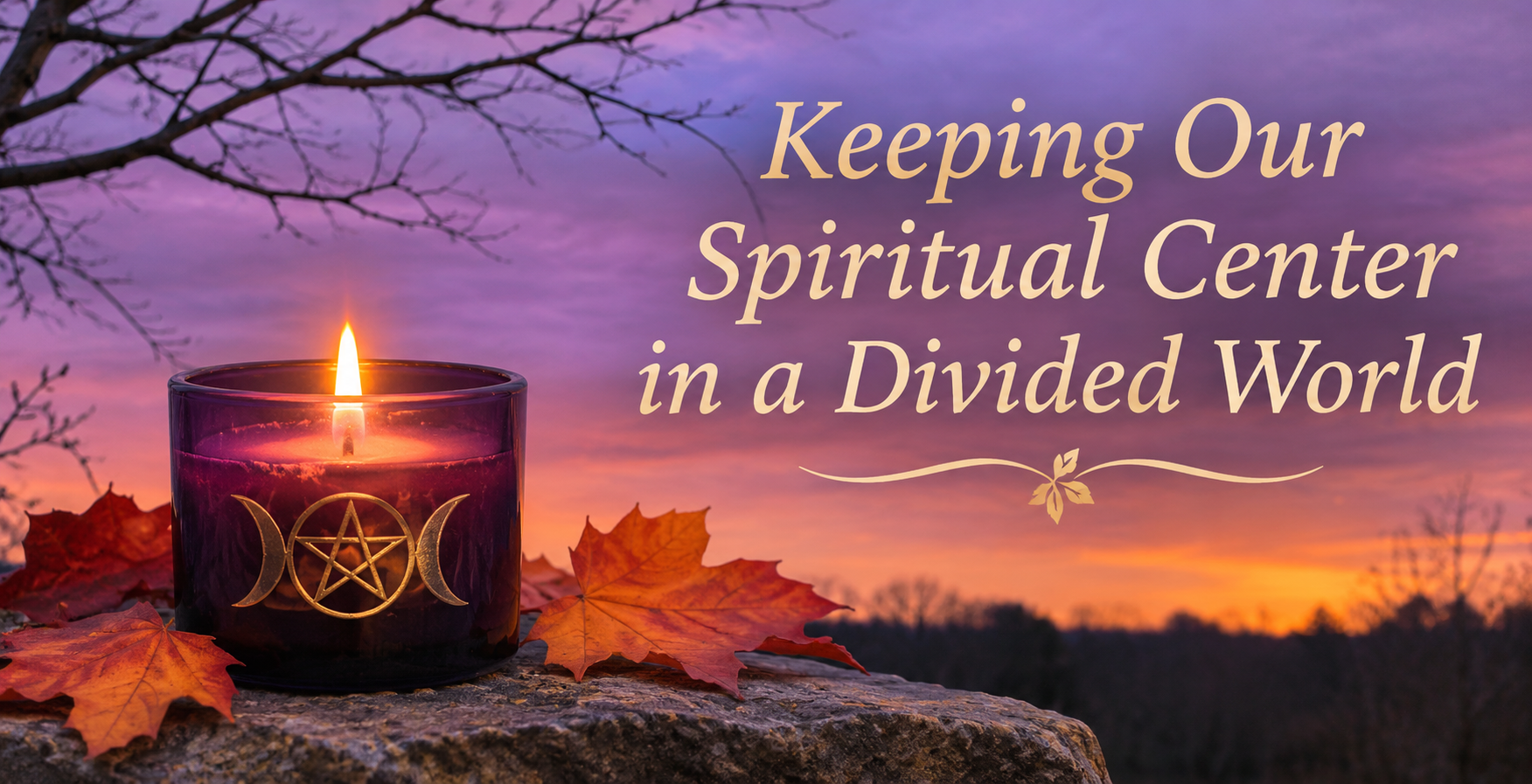
As Tuesday approaches, I imagine many people will turn toward their spiritual practices for reassurance. Candles will be lit. Prayers will be offered. Some will consult their cards or other divination tools. Others will seek the quiet companionship of trees, rivers, gardens, or the familiar presence of their household altars. Some will simply turn off the television and go to bed, which may be the most practical spiritual intervention available on election night.
I don’t intend to tell anyone what to pray for, what magic to work, or what outcome to desire. Those choices belong to each individual, informed by their own conscience and understanding of the sacred.
What I would suggest is that we remember to ask for something beyond a particular result. We might ask for clarity when fear makes everything seem urgent. We might ask for courage to act according to our principles, patience when patience is warranted, and discernment to recognize when it isn’t. We might ask for the strength to protect what matters to us without becoming so consumed by opposition that we forget what we are trying to preserve.
And perhaps we can remember to care for ourselves and one another in ordinary, tangible ways. Eat something nourishing. Get some sleep. Check on someone who is struggling. Spend time with people whose company restores you. Step away from the endless stream of commentary when you’ve reached the point where you are no longer learning anything and are merely becoming more upset.
None of that is a substitute for meaningful action. It is how we preserve the energy and steadiness to continue taking meaningful action.
Wednesday morning will arrive, whatever Tuesday brings. Some people will feel relieved. Others will feel frightened, disappointed, or angry. Some questions may remain unanswered, and some disagreements will continue long after the ballots have been counted.
Our relationships with the sacred will still be there. The natural world will continue its seasonal rhythms, largely unimpressed by our political calendars. The people who depend on us will still need us. Our communities will still have work to do. And the values we hold most deeply will still ask something of us.
We may not be able to heal every division. We may not even want to reconcile every relationship that has been damaged. But we can decide that our spiritual lives will be more than a reflection of whatever frightens or angers us on a particular day.
We can remain compassionate without surrendering our discernment. We can stand firmly in our convictions without allowing hatred to become our defining characteristic. We can acknowledge fear without giving it complete authority over our lives. And we can recognize that being spiritually centered is not a permanent state of perfect calm, but something we return to, again and again, particularly when it is difficult.
I don’t know what Wednesday will bring. I do know that I will still have my spiritual practice, my conscience, my responsibilities, and the people and principles I hold dear.
For now, that is where I intend to stand.
And I may turn off the election coverage before somebody has to pry the remote out of my hand.
Want to join the conversation about this blog post? Go to the Green Egg Forum and scroll for the forum post that relates to this article
 As Editor of the Green Egg Blog, Katrina Rasbold weaves ancient wisdom into the complexities of modern life, fostering a space for deep inquiry and magical growth. Katrina is the editor of Green Egg Magazine, a priestess, author, and co-creator of the CUSP path, working from the crossroads of tradition and transformation. She owns and operates Crossroads Occult with her husband, Eric, offering a sanctuary for those seeking mentorship, quality handmade magical items, and authentic craft. Discover her full body of work at www.katrinarasbold.com.