Posted on

The Un-Authorized Lexicon: An Unofficial Guide to Pagan Parlance

By Katrina Rasbold

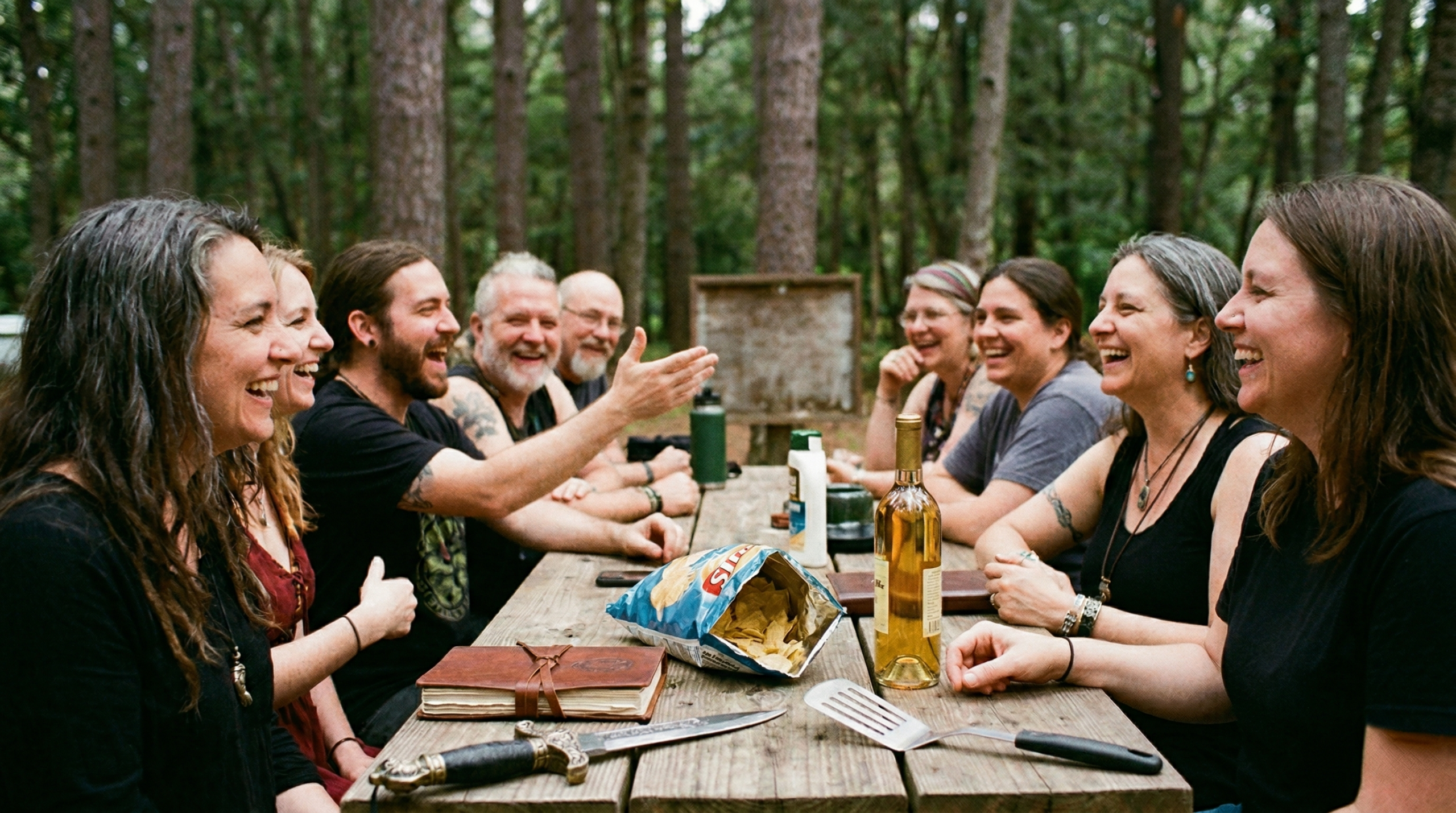
In the early days of Neopaganism, we learned a vital lesson: if you can’t laugh at your own ritual bloopers, the Gods certainly will. Over the last several decades, the Pagan movement developed a vocabulary so dense it could sink a Viking longship. In today’s Green Egg Blog, I step out of the circle and share the Inner Court, Super Secret Squirrel definitions of some of the most common magical terms.

Welcome to the Alternate Lexicon of Magical Practice. Here is what those fancy terms actually mean when the mead starts flowing and the incense gets a bit too thick. But before we get into that, I want to tell you a story. Continue reading The Un-Authorized Lexicon: An Unofficial Guide to Pagan Parlance

Posted on

The Empty Throne: Why We Need the Goddess NOW

By Katrina Rasbold

Look at the world outside your window. No, look deeper—past the blooming daffodils of the equinox and into the marrow of the collective American psyche. Can you feel the grinding? It is the sound of a massive, ancient machine—the Patriarchal Engine—running out of oil and beginning to strip its own gears. Smell that acrid “burning clutch” scent that is part metallic and part desperation.

For two thousand years, the West has been a house with only one parent. We have been raised in a spiritual and social architecture built entirely on the concept of the Singular Father: the judge, the law-giver, the punisher, and the distant king. We were told this was the “natural order.” We were told that strength is found in hierarchy, that security is found in walls, and that divinity is strictly masculine.

But the walls are cracking. The gears are screaming. And as the patriarchal structure in America today enters its most desperate, explosive phase, we are finally realizing that we aren’t just tired—we are motherless. Continue reading The Empty Throne: Why We Need the Goddess NOW

Posted on

The Great Balancing Act: Welcoming the Spring Equinox

By Katrina Rasbold

As the wheel turns to the Vernal Equinox, the world pauses for a singular, breathtaking moment of perfect equilibrium. Day and night stand as equals, holding hands across the threshold of the seasons. Here at Green Egg, we’ve always seen the Equinox not just as a date on a calendar, but as the “hatching” of a new reality.

If your winter felt like a long hibernation of the soul, you aren’t alone. But look closely: Gaia is breathing again.

Continue reading The Great Balancing Act: Welcoming the Spring Equinox

Posted on

Many Paths to the Center: Navigating Pagan Theologies

By Katrina Rasbold

In the grand, colorful tapestry of modern Paganism, there is no single “right” way to view the Divine. For decades, Green Egg has served as a forum where these diverse perspectives—often called the “many paths to the same center”—can be explored, debated, and celebrated. Whether we see the Gods as distinct individuals, facets of a single source, or expressions of the Earth herself, our theology is as varied as the ecosystems of Gaia.

To better understand our community, let’s look at how we conceptualize the Divine, from the ancient roots of polytheism to the modern shift toward gender-expansive spirituality.

Continue reading Many Paths to the Center: Navigating Pagan Theologies

Posted on

The Liturgy of the Soil: A Permaculture Rite for the Spring Equinox

By Katrina Rasbold

The Spring Equinox is often treated as a celebration of outward growth—the first green shoots, the return of the sun, and the frantic burst of planting energy. But for the modern Pagan, the Equinox is also a moment of perfect equilibrium: the exact threshold where light and dark hold hands before the sun begins its steady climb.

This year, as you prepare your garden beds, consider moving beyond viewing your land as a resource to be managed. Instead, view it as a site of theological engagement. Permaculture—with its foundational ethics of Earth Care, People Care, and Fair Share—is not just a design system; it is a profound, living liturgy. Continue reading The Liturgy of the Soil: A Permaculture Rite for the Spring Equinox

Posted on

The New Vanguard: 10 Pagan Voices Shaping Our Future

By Katrina Rasbold

As we stand at the crossroads of a shifting spiritual landscape, the torch of modern Paganism is being passed to a new generation of visionaries. While we will always honor the foundational texts of our elders, the voices rising today address the complexities of the 21st century—blending ancient wisdom with social justice, digital connectivity, and deep ecological urgency.

Unlike times in the past when we had a handful of authors defining who we are in the world as contemporary Pagans, we are now flooded with names and books to the point that it can be difficult to know who to read. Those of us who have been around for a while feel compelled to wonder who our new Janet Farrar, Laurie Cabot, Oberon Zell, Starhawk, and Raymond Buckland will be. As we begin to lose the vital icons, who steps up to continue what they began? Continue reading The New Vanguard: 10 Pagan Voices Shaping Our Future

Posted on

From Polarity to Pluralism: The Evolution of Inclusive Paganism

By Katrina Rasbold

The landscape of modern Paganism has shifted dramatically over the last fifty years. What began in the mid-20th century as a movement deeply rooted in the divine gender binary has blossomed into a diverse, decentralized spiritual umbrella that increasingly prioritizes radical inclusivity.

Continue reading From Polarity to Pluralism: The Evolution of Inclusive Paganism

Posted on

Imbolc: Because Nature Needs a Caffeine Kick (and So Do You)

By Katrina Rasbold

By the time February 1st rolls around, most of us are essentially sentient blankets. We’ve spent the last six weeks vibrating at the frequency of a slow-cooker, surviving on leftover Yule chocolate and the desperate hope that the sun wasn’t just a fever dream we all had last July.

Enter Imbolc.

While the rest of the world is distracted by groundhogs and overpriced Valentine’s candy, we Pagans are out here lighting every candle in the house to remind the Earth that it has a job to do. Imbolc (pronounced im-bulk, or em-bowl-ug if you want to sound fancy at the moot) is the “Great Quickening.” It’s that subtle, slightly frantic heartbeat beneath the frost.

Continue reading Imbolc: Because Nature Needs a Caffeine Kick (and So Do You)

Posted on

The Great Quickening: Mapping the Pendulum Swing of the Craft (1986–2026)

By Katrina Rasbold

40 Years – Gone in the blink of an eye.

To flip through the yellowed, newsprint pages of a 1980s Green Egg is to touch a different dimension. In those days, the ink came off on your fingers, and the ideas—bold, radical, and often dangerously counter-cultural—felt like they could set the paper on fire. We were a tribe of correspondences, P.O. Boxes, and wilderness gatherings where the drums beat against a silence that the modern world has all but forgotten.

Of course, Green Egg Magazine goes back to the 1960, so tack on an additional two decades. I threw a dart into the 1980s because that is when I came to the Craft and subsequently, to Green Egg Magazine.

Today, the “Old Religion” has entered the “New Information Age.” As we stand in 2026, the contrast between the Paganism of forty years ago and the Paganism of today is not just a shift in fashion; it is a fundamental evolution of how the human spirit interfaces with the Divine. Continue reading The Great Quickening: Mapping the Pendulum Swing of the Craft (1986–2026)

Posted on

The High Priestess: Where Meaning Awaits

By Tatiara

I entered the outer court of the Temple.

The first veil fell away, and the light was dim, neither day nor night. Meaning seemed to hover, unfinished, in the liminal half-darkness.

Before me, an enigmatic woman sat upon a throne, poised between two pillars. One white, one black. The air felt charged… mystical.

A mystery radiated from her. Unseen, it stirred an ancient awareness within me. Continue reading The High Priestess: Where Meaning Awaits

Posted on

10 Reasons Why Being a Pagan is Actually Pretty Cool

By Katrina Rasbold

Welcome back to the Witch At The Crossroads blog! Whether you’ve been walking the Path for decades or you’re just starting to notice that you feel a strange pull toward the moon, you’ve probably realized that Paganism isn’t exactly “mainstream.”

While the rest of the world is busy staring at screens, we’re out here talking to trees and celebrating the solstice. But beyond the mystery and the incense, there are some genuinely practical—and occasionally eclectic and quirky—reasons why being a Pagan is a fantastic way to live.

Here are ten reasons why being a Pagan is undeniably cool.

Continue reading 10 Reasons Why Being a Pagan is Actually Pretty Cool

Posted on

Pantheon – The Romans by Rachel S. Roberts

Reviewed by Katrina Rasbold

In her latest addition to the Pantheon series, historian and spiritual teacher Rachel S. Roberts invites readers to step past the marble ruins and cold statues of the history books and into the vibrant, beating heart of the Ancient World. The Romans is not just a dry recounting of dates and conquests; it is a spiritual travelogue that reanimates the “City of a Thousand Gods.” Continue reading Pantheon – The Romans by Rachel S. Roberts

Posted on

The Great Turning: Standing at the Crossroads of Dark and Light

By Katrina Rasbold


Welcome, travelers, to the ultimate crossroads in time.


The nights have stretched impossibly long, consuming the days in shades of indigo and charcoal. The air bites, the sap has sunk deep into the roots of the trees, and the Earth seems locked in an impenetrable slumber. We have reached the depth of the year.

Here at the Winter Solstice—Yule, Alban Arthan, the Longest Night—we stand at the most profound liminal space on the Wheel of the Year. As the Witch at the Crossroads, I am familiar with these in-between, liminal places where choices are made and realities shift. But this… this is the cosmic pivot point.

Many modern celebrations rush toward the light, eager to drape tinsel over the shadows and dispel the quiet with forced cheer, but the wise know that we cannot truly welcome the dawn if we have not first sat vigil in the dark.

Continue reading The Great Turning: Standing at the Crossroads of Dark and Light

Posted on

Two Lights, One Dawn: Eugene’s Historic Yule Celebration

By Echo Sherman

This winter, Eugene is about to witness something rare, radiant, and wonderfully unexpected: a Yule celebration that unites faiths, communities, and hearts in one shared evening of ritual, music, and care.

On December 21st, 2025, the First Christian Church will open its doors at 5:00 PM for a historic event: an interfaith solstice service where the Christian tradition of the Son meets the Pagan celebration of the returning light. For those who love the warmth of ceremony, the flicker of candles, and the poetry of ritual, this is a moment you won’t want to miss. Continue reading Two Lights, One Dawn: Eugene’s Historic Yule Celebration

Posted on

The Longest Night and the Promise of Light: Why We Need Yule More Than Ever

hand lighting candle

If you look out the window right now, the world probably looks a little sleepy. The trees are bare skeletons against a steel-grey sky, the ground is hard (or slushy, depending on your latitude), and the sun seems to have packed its bags and left the office by 4:00 PM. Continue reading The Longest Night and the Promise of Light: Why We Need Yule More Than Ever

Posted on

A Hedge Witch and the Elements

By Cat Gina Cole

Many people assume a Hedge Witch is simply an herb worker or a kitchen witch. In my family tradition, however, a Hedge Witch is someone who lives and works with the elements—and with psychism—every day. We define witchcraft as the ability to work with all forces of nature, both those of the physical world and those beyond the veil.

Those who follow my blog may remember my entry, “Weather Magic With Clairvoyance in Time and Space,” where I describe how I built my relationship with the Element of Air. In this article, I expand on that work by sharing a core belief from my tradition: the directions and the elements are separate things. The Direction of East is the realm where Air resides. This distinction is fundamental to how I connect with the elements. Continue reading A Hedge Witch and the Elements

Posted on

Samhain: Gateway Between Worlds and Seasons

By Katrina Rasbold

As the last leaves fall and the year’s light wanes, the veil between the worlds thins. Samhain (pronounced SOW-in or SAH-win), one of the four great fire festivals of the Celtic calendar, stands as the final spoke on the Wheel of the Year. It is both an ending and a beginning—a time when the harvest is complete, and the dark half of the year begins. Continue reading Samhain: Gateway Between Worlds and Seasons

Posted on

Elder or Oldster? Thoughts on the Wise One

by Tatiara

It began with a simple conversation in a pagan Facebook group. Someone posed a question about what constitutes an “Elder”. As the responses came, I felt something within me stir. I kept returning to that post, rereading the comments. Some were funny, others profound. A few spoke of favorite stories, or teachers they’d once known. But beneath it all, I sensed a deeper longing: a yearning for true eldership. Not just knowledge, not just age—but wisdom. The kind that holds space without needing to explain. The kind that has walked through fire and come back holding sacred embers for others. Continue reading Elder or Oldster? Thoughts on the Wise One

Posted on

Paganism and Church

By Cat Gina Cole

How did Pagans ever become a church? I thought Pagans were anti-church? These and other similar questions flood social media these days. The word “church” has become something of a swear word in our time. It is currently a word that represents control, abuse of power, corruption, telling people how to live, what to believe, and being “Our way or the highway” about every aspect of a person’s life. There is a big resistance to that now, not just in the Pagan communities but in general and they are not wrong. Christian churches do have that history to them; however, it made me wonder about the origins of the word “church” and its original meaning. Continue reading Paganism and Church